

By Peter Omopo
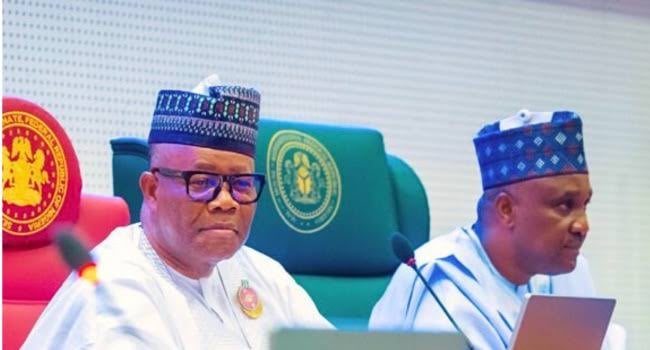
The Socio-Economic Rights and Accountability Project (SERAP) has called on the President of the Senate, Godswill Akpabio, and the Speaker of the House of Representatives, Tajudeen Abbas, to provide a detailed account of how ₦18.6 billion reportedly allocated for the construction of the National Assembly Service Commission (NASC) office complex was spent.
The organisation also urged both presiding officers to disclose the identity of the construction company that received the payments, including the names of its directors, shareholders, and registered address.
In a statement released on Sunday by its Deputy Director, Kolawole Oluwadare, and made available to PUNCH Online, SERAP alleged multiple violations of Nigeria’s Public Procurement Act, citing findings from the 2022 report of the Office of the Auditor-General of the Federation (OAuGF).
According to the report, the NASC paid ₦11.6 billion to “an unknown construction company” on August 11, 2020, for the construction of its office complex, which was to be completed within 24 months. The Auditor-General also noted that the contract was allegedly inflated by ₦6.9 billion, with an additional payment made on November 29, 2023, purportedly for the conversion of a roof garden into office space.
“The contract was reportedly awarded without a Bill of Quantity (BOQ) or pricing details. There were no records of needs assessment, public advertisement, bidding process, contract agreement, bidders’ quotations, or approval by the Federal Executive Council,” SERAP stated.
The rights group said the absence of a Bureau of Public Procurement (BPP) certificate of “no objection” further raised concerns about the legitimacy and transparency of the project.
“The Auditor-General fears that the ₦18.6 billion budgeted for the construction of the Commission’s office complex and conversion of the roof garden to office space may be missing,” the statement added.
Call for Transparency and Accountability
SERAP described the revelations as grave violations of public trust, alleging that the funds may have been misappropriated, diverted, or stolen.
“These serious allegations reflect the continuing failure of the National Assembly and its commission to uphold the principles of transparency and accountability. Explaining the whereabouts of the money, naming the company involved, and prosecuting those responsible will serve the public interest,” the group said.
The organisation emphasised that the National Assembly must lead by example if it expects to credibly exercise oversight over other branches of government and anti-corruption agencies.
“The National Assembly can only demonstrate genuine leadership by addressing corruption within its own system,” SERAP stated.
Ultimatum to Act
The organisation gave Akpabio and Abbas a seven-day ultimatum from the date of receipt or publication of its letter to act on the allegations.
If there is no satisfactory response within the timeframe, SERAP warned that it would initiate appropriate legal action to compel the National Assembly and the NASC to comply with its demands.
SERAP also urged the legislature to refer the case to anti-corruption agencies such as the Economic and Financial Crimes Commission (EFCC) and the Independent Corrupt Practices and Other Related Offences Commission (ICPC) for a full-scale investigation, prosecution where necessary, and recovery of any missing public funds.
“Accounting for the allegedly missing ₦18.6 billion and publishing the details of the contractor would restore public confidence and show that the National Assembly is committed to transparency, accountability, and the rule of law,” the statement concluded.
