

By Peter Omopo
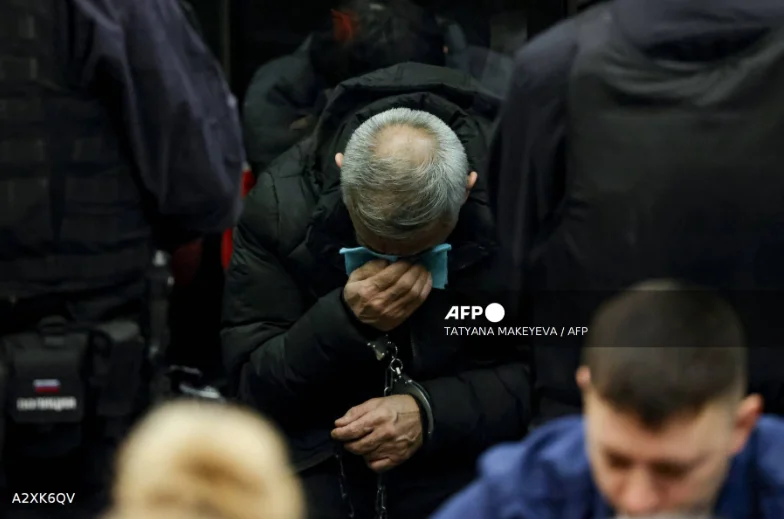
A Russian court has sentenced 15 men, including four gunmen, to life imprisonment over the 2024 attack on a concert hall in Moscow that killed 150 people.
The verdict was delivered on Thursday by a military court in Moscow in connection with the Crocus City Hall attack, the deadliest assault in Russia in more than two decades.
Relatives of some of the victims of the March 22, 2024 attack, which was claimed by the Islamic State group, were present in court as the judgement was announced.
The four gunmen identified as Shamsidin Fariduni, Dalerdzhon Mirzoyev, Makhammadsobir Fayzov and Saidakrami Rachabolizoda, all citizens of Tajikistan, were found guilty of carrying out the attack and were sentenced to life imprisonment.
The attackers had stormed the concert hall, opened fire on attendees and later set the building ablaze, trapping many victims inside.
Eleven other men, including some Russian citizens, were also sentenced to life imprisonment for acting as accomplices and maintaining terrorist links connected to the attack.
In addition, four other men, including a father and his sons, received prison sentences ranging from 19 to 22 years for their involvement with the attackers.
The attack occurred shortly before a scheduled performance by Soviet-era rock band Picnic at the concert venue located in the Moscow suburbs.
More than 600 people were injured in the incident, while six children were among those killed.
The assault marked Russia’s worst attack since the 2004 Beslan school siege.
The incident happened two years after Russia launched its military campaign in Ukraine, during a period when authorities had dismissed warnings from the United States about a possible imminent attack.
At the time, the Kremlin suggested a possible link to Ukraine but did not provide evidence.
Following the verdict, Russia’s Investigative Committee said it had established that the attack was planned and carried out in the interests of Kyiv.
The committee also accused the suspects of plotting additional attacks in Dagestan.
During the trial, the four gunmen, aged between 20 and 31 at the time of the attack, appeared in court inside a glass defendant’s cage under heavy security.
Investigators said the suspects had previously worked in different occupations including taxi driving, factory work and construction.
According to media reports, one of the attackers, Mirzoyev, may have been radicalised after his brother was killed while fighting in Syria.
Shortly after their arrest in 2024, the suspects were brought to court showing visible signs of torture, with one of them barely conscious and appearing in a wheelchair.
Videos circulating on social media at the time appeared to show violent interrogations allegedly carried out by security operatives.
Reports also indicated that two of the suspects had requested permission from the court to fight for Russia in the war in Ukraine instead of serving life sentences.
Throughout the conflict, Russian authorities have recruited prisoners for military service with the promise of reduced sentences if they survive combat.
However, prosecutors also demanded that relatives of one of the gunmen be stripped of their Russian citizenship.
The attack and its aftermath triggered a tightening of anti-migrant policies and rhetoric in Russia, particularly targeting migrants from Central Asia.
The move strained relations between Moscow and several Central Asian countries, whose governments called on Russia to respect the rights of their citizens.
Russia’s economy has long relied on millions of migrant workers from Central Asia, but migration to the country has declined since the start of the Ukraine war and further dropped following the crackdown after the Crocus City Hall attack.
