

By Peter Omopo
Rivers State Governor, Siminalayi Fubara, has raised concerns over what he described as a “Federal Certificate of Occupancy” allegedly issued by the Office of the Surveyor-General of the Federation, warning that it poses a threat to land ownership and title administration in the state.
Fubara said the development runs contrary to Section 1 of the Land Use Act Cap L5 LFN 2004, which vests all land within a state in the governor as trustee.
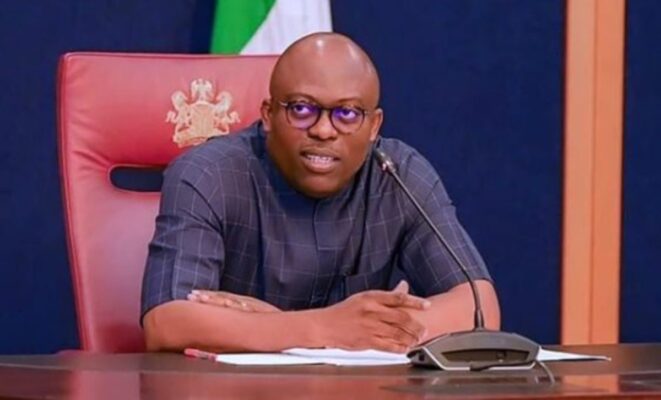
The governor spoke on Thursday in Port Harcourt while serving as Special Guest at the 4th Annual National Conference and Retreat of the Association of Private Practising Surveyors of Nigeria (APPSN), a subgroup of the Nigerian Institution of Surveyors.
Addressing participants at the conference themed, “Mapping the Future: The Vital Roles of Surveyors in the Nigerian Oil and Gas Industry,” Fubara described the theme as significant, noting that Rivers State remains a major hub for oil refining, exploration, and production in Nigeria and the West African sub-region.
He highlighted the critical role of surveyors in governance and development, particularly in land use management, infrastructure provision, environmental planning, and conflict resolution. According to him, surveyors provide precise and identifiable site mapping through scientific measurement of distances, angles, and elevations, producing reliable spatial data for development planning.
However, the governor expressed reservations over what he termed threats to land ownership in the state.
“The threat to land ownership and title in Rivers State by the production and issuance of ‘Federal Certificate of Occupancy,’ allegedly issued by the Office of the Surveyor-General of the Federation and other affiliated Federal MDAs to claim land and waterways in Rivers State, is contrary to Section 1 of the Land Use Act,” he said.
Fubara also raised concerns over alleged land grabbing through the procurement of illegal survey plans and the superimposition of survey pillars and numbers. He further stressed the need for adequate compensation to landowners by licence holders, calling for professional intervention in view of current economic realities.
The governor underscored the importance of environmental protection in planning processes, urging stakeholders to safeguard green areas, create marine protected zones, and preserve forests during oil exploration activities. He advocated minimising the physical footprint of seismic operations, adopting green technologies, conducting thorough Environmental Impact Assessments, and ensuring rapid restoration of affected areas.
Despite the concerns, Fubara commended APPSN for choosing Port Harcourt as the venue for its conference, describing the decision as a testament to the peaceful and investment-friendly environment in Rivers State.
In his remarks, the National Chairman of APPSN, Simepreye Kalio, said the association is strategically positioned to play complementary roles within the Nigerian Institution of Surveyors, adding that such collaboration is vital to the survival and advancement of the profession.
The Rivers State Chairman of APPSN, Andy Nwikinane, emphasised that the oil and gas industry relies heavily on accurate geospatial data, hydrographic surveys, engineering positioning, and land administration frameworks for effective and sustainable operations.
He noted that surveyors support upstream operations through positioning of offshore platforms and pipeline routes, while in the midstream and downstream sectors they ensure precise alignment of pipelines, refineries, and distribution networks, thereby enhancing safety, cost efficiency, and regulatory compliance.
Nwikinane added that surveyors are increasingly embracing emerging technologies such as Geographic Information Systems (GIS), remote sensing, drone mapping, LIDAR, real-time GPS positioning, and digital mapping to improve asset management and monitoring in the oil and gas sector.
President of the Nigerian Institution of Surveyors, Pius Eze, urged participants to utilise the retreat for professional development and networking opportunities.
The conference brought together stakeholders to deliberate on strengthening professional capacity and adopting best practices within Nigeria’s oil and gas industry.
