

By Peter Omopo
Diplomatic relations between Nigeria and the United States have undergone a dramatic shift over the past three months, moving from public tension and sharp rhetoric to coordinated military cooperation that culminated in precision airstrikes on terrorist targets in Northwest Nigeria.
The evolution followed the United States’ designation of Nigeria as a “Country of Particular Concern” (CPC) in October, a move accompanied by claims from US President Donald Trump alleging persecution of Christians in the country. The designation triggered strong reactions from Abuja, which rejected the allegations as misleading and inconsistent with realities on the ground.
By Christmas Day 2025, however, the relationship had pivoted to active counter-terrorism collaboration, with intelligence-driven airstrikes carried out against Islamic State (ISWAP/ISIS) enclaves in Sokoto State. President Trump confirmed the operation via his official Truth Social account, while Nigerian authorities acknowledged their role in providing intelligence and granting approval for the strikes.
In a statement issued on Friday by the Ministry of Foreign Affairs and signed by its spokesperson, Kimiebi Ebienfa, Nigeria said it was engaged in “structured security cooperation with international partners, including the United States of America,” to address terrorism and violent extremism. The United States Africa Command (AFRICOM) also confirmed intelligence coordination with Nigerian authorities leading to the operation.
Foreign Affairs Minister Yusuf Tuggar later disclosed that the Nigerian government supplied the intelligence that enabled the strikes and formally approved the operation, describing it as part of ongoing counter-terrorism cooperation between both countries.
CPC Proclamation and Nigeria’s Response
On October 31, President Trump declared Nigeria a Country of Particular Concern, citing allegations of a “Christian genocide.” In a post shared on Truth Social and the White House’s official platforms, Trump claimed thousands of Christians were being killed and called for immediate congressional scrutiny.
The Federal Government swiftly rejected the designation. In a statement from the Ministry of Foreign Affairs, Nigeria said the claims were inaccurate and failed to reflect the country’s complex security challenges, which affect citizens across religious and ethnic lines. The government stressed its commitment to religious freedom, unity, and peace, while welcoming constructive international engagement.
High-Level Security Engagements
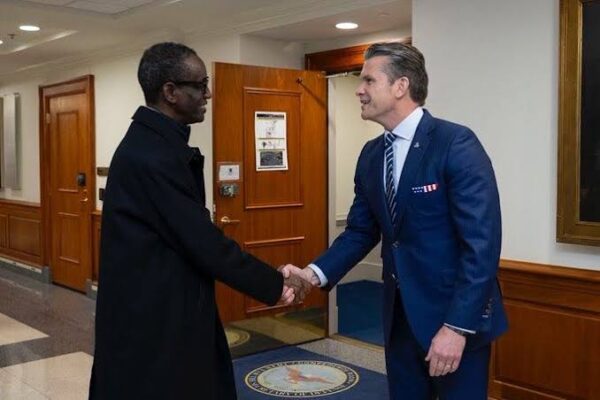
Diplomatic engagement intensified in November. On November 20, US Secretary of War Pete Hegseth hosted Nigeria’s National Security Adviser (NSA), Mallam Nuhu Ribadu, at the Pentagon. Discussions focused on strengthening bilateral cooperation against terrorism and addressing violence linked to extremist groups in West Africa.
According to a Pentagon readout, both sides reaffirmed their resolve to deepen security collaboration, with the US emphasising the need for sustained action against attacks on civilian communities.
Four days later, on November 24, the Presidency announced that Nigeria had strengthened its alliance with the US Department of War following meetings involving senior officials across the US Congress, the White House Faith Office, the State Department, the National Security Council, and the Department of War. The Nigerian delegation, led by NSA Ribadu, rejected genocide allegations and emphasised that insecurity in Nigeria cuts across all communities.
Congressional Engagements and Fact-Finding Visits
US Congressman Riley Moore also played a prominent role in the engagement. On November 20, he met with the Nigerian delegation in Washington, describing discussions as frank and productive. Moore said the US was committed to working with Nigeria to combat terrorism, including Boko Haram and ISWAP, while urging tangible action to protect vulnerable communities.
In early December, Moore visited Nigeria as part of a fact-finding mission. He later described the visit as productive and expressed satisfaction with Nigeria’s willingness to cooperate on security issues. The visit included meetings with senior officials and vulnerable communities.
NSA Ribadu confirmed hosting a US Congressional delegation in Abuja, noting that discussions centred on counter-terrorism cooperation, regional stability, and strengthening the strategic partnership between both countries.
Following the visit, Moore praised Nigeria’s efforts, including the rescue of abducted schoolchildren, and said discussions identified concrete steps that could enhance security if fully implemented.
Airstrikes and Renewed Cooperation
The diplomatic efforts culminated on December 26, when the US carried out precision airstrikes on terrorist enclaves in Sokoto State. President Trump confirmed the strikes, while Nigeria acknowledged providing intelligence and authorisation for the operation.
Minister Tuggar said the strikes were part of a broader counter-terrorism framework between Nigeria and the United States, underscoring a shift from public discord to operational cooperation.
The development marks a significant turn in US–Nigeria relations, highlighting how sustained diplomatic engagement and security dialogue transformed a period of sharp disagreement into coordinated action against terrorism.
