

August 29, 2021
Written by: Olumide Holloway (King Olulu)
Revised and Directed by: Diran “Direxblows” Aderinto
Genre: Drama / Relationship / Psychological
Format: Short Film Script
Review by: [Critic’s Name]
Overview
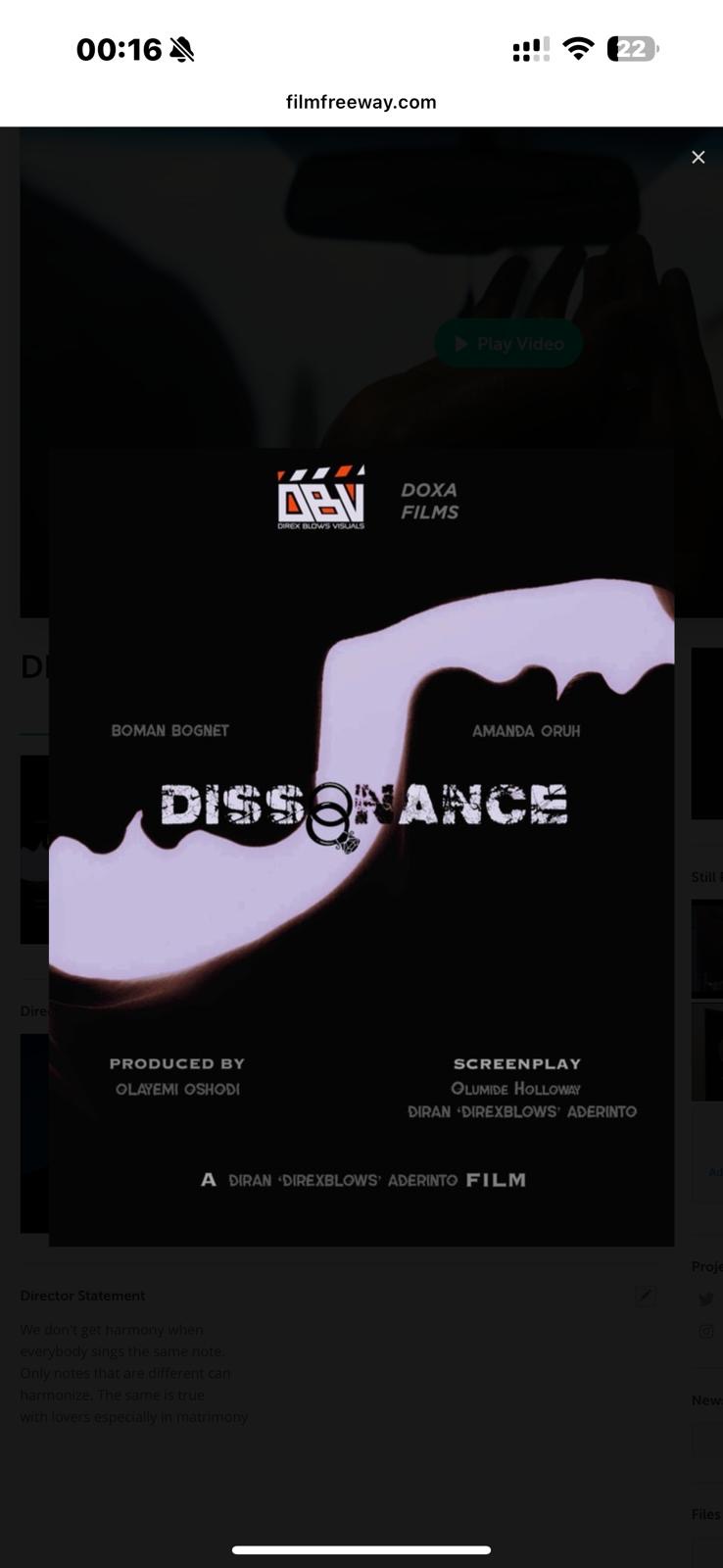
Dissonance is a quietly arresting and emotionally layered short film that interrogates the subtle unraveling of love through the lens of a young marriage. Written by Olumide Holloway and directed by Diran “Direxblows” Aderinto, the film avoids melodrama in favour of realism, nuance, and a poetic understanding of emotional disintegration. What begins as a celebration of union soon becomes a compelling meditation on unmet expectations, miscommunication, and the psychological burden of shared space.
With minimal locations and a tightly focused cast, Dissonance proves that deeply human stories need neither spectacle nor high-concept premises to resonate. This is an emotionally intimate chamber piece that succeeds through its writing, performances, and most of all, its artistically grounded direction.
Narrative and Structure
The script’s structure is episodic, marked by time-stamped transitions such as “Two Months In” and “Five Months In,” which lend the story a diary-like rhythm. Rather than a conventional three-act structure, the film invites the viewer to observe the gradual erosion of connection through silences, slights, and moments left unresolved. Each interaction feels like a natural consequence of the one before it, resulting in a deeply immersive emotional arc.
From a honeymoon-like beginning to the heavy quiet of the therapist’s room, the progression feels earned and intimately familiar. The story structure mirrors how real relationships break down not with spectacle, but with small cracks that deepen over time.
Cinematic Language and Directorial Approach
What elevates Dissonance is not just what it says, but how it is shown. Diran’s direction is assured and restrained, with a mature understanding of cinematic grammar. Emotional
transitions are cleverly visualised through continuity in objects, gestures, and spaces. For instance, a wedding ring shown early as a symbol of unity becomes a quiet visual echo of fading intimacy in later scenes.
A standout transition occurs when Brenda, returning from a trip, finds a stack of dirty dishes in the sink. The emotional punch is not verbalised. Instead, we cut to her collapsing onto the bed in frustrated silence. That single cut captures emotional labour, neglect, and resignation all at once. These moments of visual storytelling are among the film’s finest.
Diran employs orbiting movements to reflect the couple’s cyclical tension and uses tight shots to emphasise emotional claustrophobia. His framing allows discomfort to linger, refusing to release us too soon. The attention to small domestic details like a toothpaste cap, a kitchen sink, or a locked phone turns the ordinary into quiet metaphors for disconnect.
Crucially, Diran does not over-direct. He understands the power of silence, of shared glances, of what is not said. The film’s emotional rhythm is built just as much from pauses as from dialogue, allowing space for the audience to breathe inside each moment.
Characterisation and Artistic Interpretation
Fred and Brenda are crafted with nuance, and neither character is presented as hero or villain. Fred’s arc wrestles with emotional entitlement and frustration. Brenda navigates exhaustion from both physical and emotional labour. Their grievances are real, their perspectives valid, and their pain never sensationalised.
Diran’s tone allows these characters to be contradictory, caring but careless, vulnerable but guarded. He resists moralising and instead creates space for empathy. Actors stepping into these roles would find a wealth of emotional complexity beneath the stillness.
The script wisely uses subtext throughout. Fred’s resentment is not just in what he says, but in how he avoids saying certain things. Brenda’s fatigue is revealed in her body language, her silences, and the way she emotionally withdraws from everyday tasks. This trust in the audience to read the characters rather than be told what to feel is a sign of confident storytelling.
Themes and Contemporary Relevance
Dissonance speaks directly to a generation grappling with the myth of romantic permanence. In a culture of hyper-communication and low emotional bandwidth, the film examines how relationships can die slowly even when love still lingers.
Themes of emotional labour, gender roles, resentment, and unspoken expectations are tackled with sensitivity. The story refrains from judgement. Instead, it offers an observation that love is
not just about grand gestures, but about the quiet, daily act of seeing and choosing one another. When that stops, connection begins to rot, imperceptibly at first, then entirely.
The Robert Anderson quote that ends the film, “In every union more than a week old, there are grounds for divorce. The trick is to find and continue to find grounds for marriage,” perfectly encapsulates the film’s core question.
Constructive Criticism
While the script excels in subtlety and subtext, one area for possible development lies in emotional variation. The conflict, though authentic, occasionally maintains a flat emotional tempo. A moment of rupture, humour, or unexpected tenderness midway through could add dynamic contrast and amplify the emotional descent that follows.
This is not a flaw but a creative opportunity to disrupt the rhythm briefly and make the story’s quieter moments even more impactful.
Final Verdict
Dissonance is a standout short film. Emotionally intelligent, visually poetic, and artistically refined, it offers an honest portrayal of modern love in decline. Diran’s direction breathes cinematic life into a script that refuses to simplify love’s complexities. Holloway’s writing, marked by restraint and realism, offers actors and viewers alike a textured exploration of modern intimacy.
It is a rare thing, a short film that does not shout yet speaks volumes. And while it depicts disconnection, Dissonance ultimately connects with truth, with tenderness, and with anyone who has ever felt unseen by the one they love.
⭐⭐⭐⭐☆
4 out of 5 stars
A raw, poetic dissection of modern marriage. Subtle, smart, and heartbreakingly real.
