

By Peter Omopo
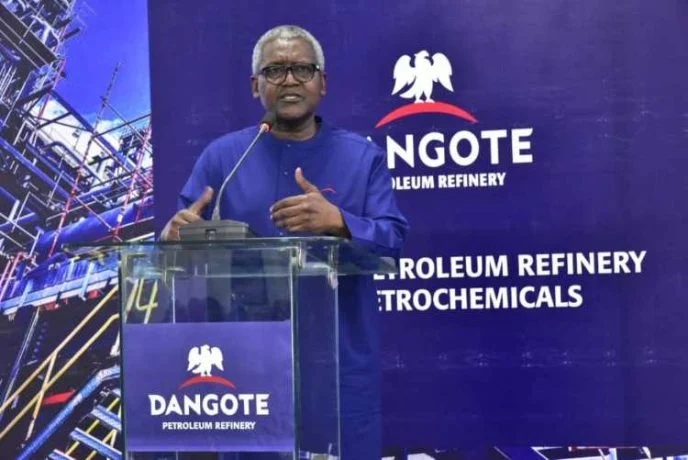
Concerns over a potential monopoly in Nigeria’s petroleum sector have intensified as stakeholders warn that the growing dominance of the Dangote Petroleum Refinery could expose consumers to price manipulation and supply risks.
Industry experts, economists, labour unions and private sector leaders raised the alarm after the Nigerian Midstream and Downstream Petroleum Regulatory Authority (NMDPRA) confirmed that no petrol import licences have been issued in 2026. The regulator explained that imports were no longer necessary because domestic production now meets national demand.
According to data released by the NMDPRA, local refineries supplied about 36.5 million litres of petrol daily in February 2026, while imports accounted for only three million litres per day, bringing total daily supply to 39.5 million litres. The Dangote refinery alone provided roughly 92 per cent of this supply, effectively positioning it as the dominant player in Nigeria’s estimated ₦14.4 trillion annual petrol market.
The development marks a major shift for Nigeria, which for decades relied heavily on imported fuel due to the poor performance of its state-owned refineries in Port Harcourt, Warri and Kaduna.
Finance Minister Wale Edun said the Federal Government would maintain market-based pricing for petroleum products despite the changes in the supply structure. Speaking during a television programme, Edun stated that government intervention in fuel pricing would only occur as a last resort.
Energy experts, however, warned that relying heavily on a single refinery could create structural risks. Professor Emeritus Wumi Iledare noted that regulatory announcements halting imports could encourage speculation and strategic market positioning among industry players.
He explained that participants might attempt to gain logistical advantages or engage in opportunistic pricing as they compete for influence in a transitioning market.
Similarly, energy law expert Professor Dayo Ayoade said the NMDPRA must ensure competition and transparency in the downstream petroleum sector. He attributed the refinery’s dominance not to deliberate market control but to the absence of alternative refining capacity.
“The fact that the market depends heavily on Dangote’s output reflects Nigeria’s lack of functional refineries,” Ayoade said, adding that regulators still retain the authority to penalise the refinery if it abuses its dominant position.
Concerns were also raised by industry analysts over the country’s energy security. Jeremiah Olatide, Chief Executive Officer of petroleumprice.ng, warned that relying on one refinery for most of Nigeria’s petrol supply could expose the country to severe supply disruptions.
He suggested maintaining a balance between local refining and imports to reduce risks. According to him, a 70 per cent local production and 30 per cent import ratio would provide better energy security than the current structure.
Labour leaders also called for temporary government intervention to protect consumers. The Assistant Secretary-General of the Nigeria Labour Congress, Christopher Onyeka, argued that a monopoly in such a critical sector could allow a single supplier to dictate prices.
He urged the government to introduce temporary price controls and negotiate a pricing framework with the refinery while also reducing taxes on petroleum products to lower pump prices.
Economist Aliyu Alias echoed similar concerns, warning that if a single supplier controls over 90 per cent of the fuel market, it could effectively determine petrol prices.
Members of the organised private sector, however, opposed the idea of price regulation. The Chief Executive Officer of Economic Associates, Ayo Teriba, warned that introducing price controls could reverse reforms implemented after the removal of the petrol subsidy.
He suggested that the government should instead provide short-term relief measures to cushion the effects of rising energy costs without distorting the market.
The Director of the Centre for the Promotion of Private Enterprise, Muda Yusuf, also rejected price regulation, stating that it could create economic distortions. He recommended reducing regulatory charges imposed on refiners and fuel suppliers to help lower pump prices.
Meanwhile, the Chief Executive of the NMDPRA, Saidu Mohammed, defended the decision to halt petrol import licences, saying the country must protect the gains achieved through domestic refining.
He explained that Nigeria’s petroleum sector had evolved through different phases—from early domestic refining to heavy import dependence after state-owned refineries collapsed.
According to him, the commissioning of the Dangote refinery represents a new phase in the sector, reducing reliance on imports and strengthening domestic refining capacity.
Globally, oil markets have also been affected by rising geopolitical tensions in the Middle East. The International Energy Agency announced that member countries would release 400 million barrels of oil from strategic reserves to stabilise markets amid supply disruptions linked to the conflict involving Iran and the United States.
Following a recent reduction in petrol gantry prices by the refinery, some filling stations in Nigeria have begun adjusting their pump prices, which currently range between ₦1,130 and ₦1,150 per litre, although a few outlets still sell at higher rates.
Experts say the long-term solution to monopoly concerns in Nigeria’s fuel market is the development of additional refineries to create competition and ensure stable pricing for consumers.
