

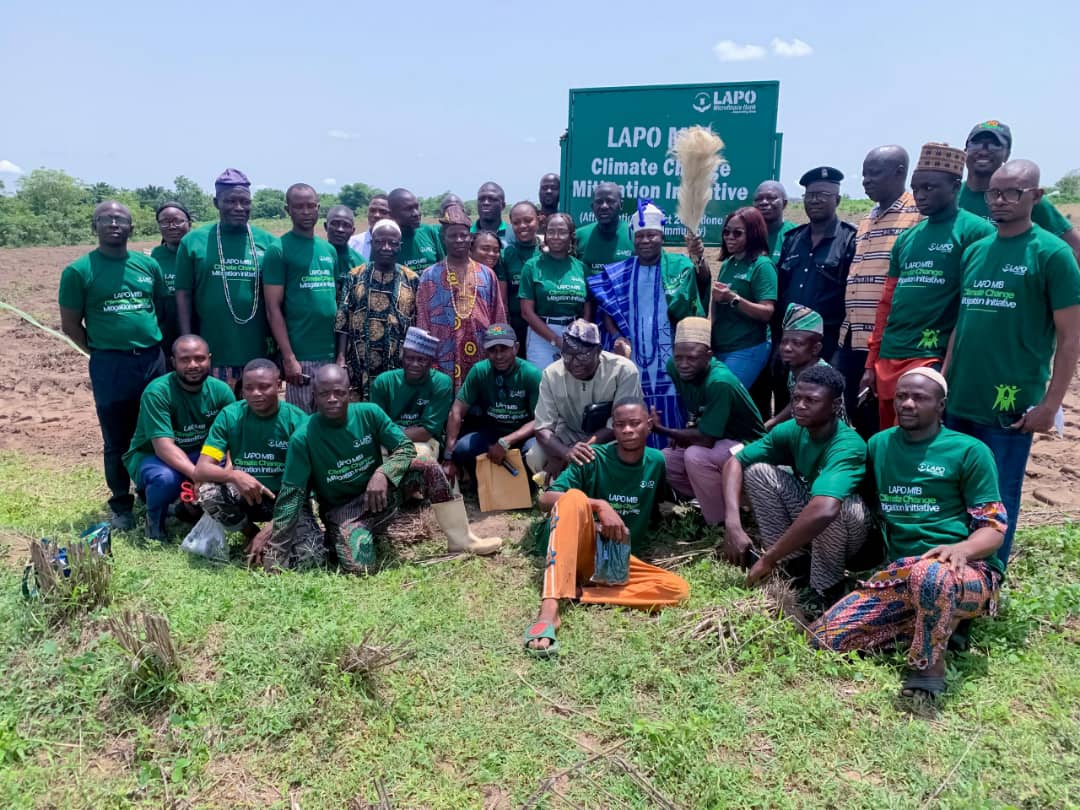
As the world observes World Environment Day 2026 under the theme “Inspired by Nature. For Climate. For Our Future,” LAPO Microfinance Bank (LAPO MfB) has reaffirmed its leadership in climate action and environmental sustainability through expanded green financing, large-scale ecosystem restoration, and strategic renewable energy partnerships.
Aligned with the global #NowForClimate campaign, the Bank’s interventions continue to demonstrate how financial inclusion can be a powerful catalyst for environmental protection and climate resilience.
A major highlight of LAPO MfB’s environmental impact is its sustained commitment to green financing, having disbursed over ₦59 billion in clean energy and environmentally focused loans. This positions the Bank as one of the foremost drivers of inclusive climate finance in Nigeria, enabling low-income households and micro-entrepreneurs to transition to cleaner and more sustainable energy solutions.
At the core of its climate intervention is a structured clean energy financing framework anchored on three pillars: Renewable Energy (solar solutions), Bio-Energy (gas systems), and Clean Cooking (energy-efficient cookstoves). Through this model, LAPO MfB continues to expand access to safer, cleaner, and more reliable energy sources for underserved communities.
The urgency of this intervention is underscored by global realities: approximately 75 per cent of greenhouse gas emissions are linked to fossil fuel use, contributing to an estimated 3.2 million premature deaths annually. In addition, over 186 million children worldwide still attend schools without electricity—an energy access gap LAPO MfB is actively addressing through targeted financing and partnerships.
To accelerate the adoption of clean energy technologies, the Bank has built a robust ecosystem of partners including Sunking, d.light, Oando Gas, TDS Technology, SALPHA Energy Limited, Koolboks Limited, Bluetti Energy Nigeria Limited, Atmosfair Climate & Sustainability Limited, DAG (CNG Tricycles), Burn Stove Nigeria Limited, Spiro Mobility Solutions Nigeria Limited, IZILI (formerly Baobab Plus Nigeria Ltd), Eja-Ice, Ecowaka, and SunFi. These collaborations span solar home systems, clean cooking solutions, gas distribution systems, cold storage, electric mobility, and digital energy financing platforms.
In addition to clean energy financing, LAPO MfB has demonstrated strong leadership in ecosystem restoration. In partnership with the International Institute of Tropical Agriculture (IITA), the Bank supported the planting of over 3,000 trees across communities in Ado-Awaye & Pade School of Science in Oyo and Aba Aiyepe in Ogun States in 2025. The initiative contributes to carbon sequestration, biodiversity conservation, and long-term climate resilience at the community level.
This initiative aligns with Nigeria’s obligations under the Paris Agreement and supports the achievement of several Sustainable Development Goals (SDGs), including SDG 7 (Affordable and Clean Energy), SDG 13 (Climate Action), SDG 15 (Life on Land), and SDG 17 (Partnerships for the Goals).
The Bank’s commitment to environmental sustainability also includes direct CSR interventions such as the donation of 50 solar home systems valued at ₦5.23 million in January 2023, providing clean and reliable lighting to underserved households.
Speaking on the significance of World Environment Day, the Director of Marketing and Communications, LAPO Microfinance Bank, Oluremi Akande, stated:
“Climate change demands urgent, practical, and inclusive solutions. At LAPO Microfinance Bank, we are deliberately financing the transition to clean energy while ensuring that low-income households are not left behind. Our investments in solar energy, clean cooking solutions, and ecosystem restoration reflect our belief that sustainability must be accessible, scalable, and transformative.”
He added that the Bank remains committed to expanding its impact through innovative partnerships and sustained green financing interventions that improve livelihoods while protecting the environment.
As global climate risks intensify, LAPO MfB continues to position itself at the intersection of financial inclusion and environmental sustainability—demonstrating that responsible finance is key to building a low-carbon and climate-resilient future.
