

By Peter Omopo
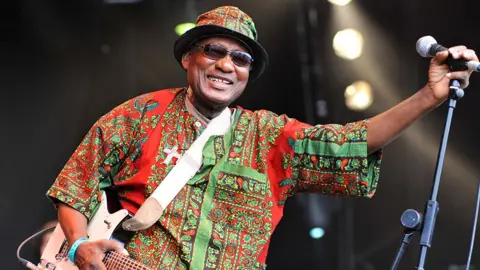
Ghana’s music industry is in mourning following the death of legendary guitarist, composer and highlife pioneer, Ebo Taylor, who passed away at the age of 90.
Taylor’s family confirmed his death on Sunday via a statement shared on his official Instagram page, though the cause of death was not disclosed. The Musicians Union of Ghana (MUSIGA) later announced that the iconic musician died at the Saltpond Hospital.
His passing came at a symbolic moment in his celebrated life and career — just one day after the launch of the inaugural Ebo Taylor Music Festival and exactly one month after his 90th birthday.
Describing the loss, a statement on his social media page read: “The world has lost a giant. A colossus of African music. Ebo Taylor passed away yesterday, a day after the launch of the Ebo Taylor Music Festival and exactly a month after his 90th birthday, leaving behind an unmatched artistic legacy.”
Born Deroy Taylor on January 6, 1936, in Cape Coast, Ebo Taylor rose to prominence in the late 1950s and 1960s during the golden era of highlife music in Ghana. He built his early reputation performing with leading bands such as the Stargazers and the Broadway Dance Band, earning acclaim for his intricate guitar work and sophisticated compositions.
Over a career spanning more than six decades, Taylor became known for pushing musical boundaries, fusing traditional Ghanaian rhythms with jazz, funk, soul and early Afrobeat influences. His innovative approach helped shape modern African music and inspired generations of musicians across the continent and beyond.
A defining period of his career occurred in the 1960s when he relocated to London with the Black Star Highlife Band, where he collaborated with Afrobeat pioneer Fela Kuti. After returning to Ghana, Taylor led prominent ensembles including the Ghana Black Star Band and the Uhuru Dance Band, while also working closely with celebrated artists such as CK Mann, Pat Thomas and the Apagya Show Band during the 1970s.
Although widely revered in West Africa for decades, Taylor’s international recognition surged in 2010 following the global release of his album Love and Death on Strut Records. The renewed spotlight led to further critically acclaimed projects, including Appia Kwa Bridge (2012) and Yen Ara (2018).
His enduring legacy is preserved in a catalogue of timeless songs such as Heaven, Atwer Abroba, Life Stories, Ayesama, Saana and You Need Love.
Ebo Taylor is widely regarded as one of the most influential figures in Ghana’s musical history, leaving behind a body of work that continues to resonate across Africa and the global music scene.
