

By Peter Omopo
The Federal Government has launched a nationwide rollout of one million improved climate-smart hybrid cocoa seedlings in a major push to revitalise Nigeria’s cocoa industry, increase farmers’ incomes, expand export earnings, and create employment opportunities for thousands of young Nigerians.
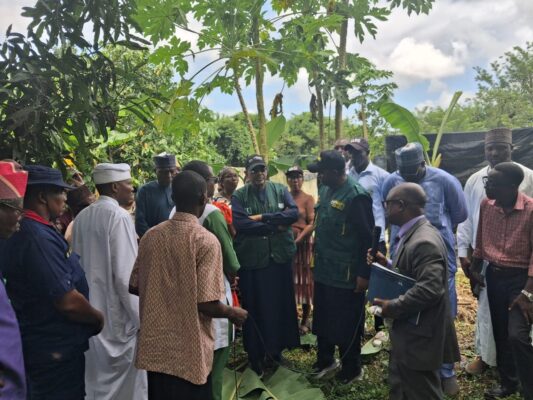
The initiative, flagged off on Wednesday at the Cocoa Research Institute of Nigeria (CRIN) in Ibadan, Oyo State, forms part of the National Cocoa Development Plan under President Bola Ahmed Tinubu’s Renewed Hope Agenda.
Speaking at the ceremony, the Minister of Agriculture and Food Security, Senator Abubakar Kyari, described the programme as a strategic national intervention designed to restore Nigeria’s position as one of the world’s leading cocoa-producing nations.
According to the minister, the exercise represents far more than the distribution of planting materials, noting that it marks the beginning of a comprehensive transformation of the country’s cocoa value chain.
He said the government is determined to rebuild the sector by improving farmers’ livelihoods, increasing export revenues, strengthening value addition, and making Nigeria more competitive in the global cocoa market.
Kyari acknowledged that despite Nigeria’s favourable climate, experienced farmers, established research institutions, and expanding private sector, cocoa production has been hampered by ageing plantations, low productivity, climate change, inadequate investment, poor access to improved seedlings, and limited value addition.
To reverse the trend, he said the Federal Government is implementing reforms across research, financing, extension services, sustainability, market access, processing, and productivity.
At the centre of the programme is the distribution of one million improved hybrid cocoa seedlings developed by CRIN. The seedlings are high-yielding, mature earlier than conventional varieties, and possess enhanced resistance to diseases and climate-related challenges.
The minister explained that the seedlings would be used to rehabilitate ageing cocoa plantations while supporting the establishment of new commercial farms across cocoa-producing states.
He added that farmers would also benefit from extension services to encourage the adoption of improved agronomic practices capable of increasing yields and ensuring long-term sustainability.
Kyari further disclosed that the government is expanding local cocoa processing capacity to reduce dependence on raw bean exports while promoting higher-value processed products capable of generating greater foreign exchange earnings.
He also revealed that Nigeria is strengthening traceability systems and farm mapping to comply with the European Union Deforestation Regulation (EUDR), a move expected to improve access to premium international markets.
According to him, the National Cocoa Management Committee and the National Task Force on EUDR are working with stakeholders to ensure compliance with global standards and enhance Nigeria’s competitiveness.
The minister called on state governments, financial institutions, research organisations, development partners, processors, exporters, private investors, and farmer associations to deepen investments across the cocoa value chain.
He urged cocoa farmers receiving the improved seedlings to embrace modern farming practices, work closely with agricultural extension officers, and adopt innovations that would improve productivity and sustainability.
Kyari also commended CRIN, state governments, development partners, private sector organisations, and farmer groups for supporting the initiative, expressing confidence that the programme would usher in a new era for Nigeria’s cocoa industry.
In his welcome address, the Permanent Secretary of the Federal Ministry of Agriculture and Food Security, Dr. Marcus Olaniyi Ogunbiyi, described cocoa as one of Nigeria’s most strategic agricultural commodities and a major source of livelihood for farming households across producing states.
He noted that the successful production of one million improved cocoa seedlings under the Federal Government’s Public-Private Partnership framework demonstrates the benefits of collaboration among government agencies, research institutions, private investors, development partners, and farming communities.
According to Ogunbiyi, the initiative is expected to increase productivity, improve farmers’ incomes, generate employment, boost foreign exchange earnings, enhance Nigeria’s competitiveness, and contribute to sustainable economic growth.
Representing the Olubadan of Ibadan, Oba Rasheed Ladoja, the Ajiroba of Ibadan, Professor Soji Adejumo, pledged the continued support of Ibadan communities for the Federal Government’s agricultural policies aimed at improving farmers’ welfare and achieving food security.
Speaking on behalf of beneficiaries, cocoa farmer Alaba Adegoke assured the government that farmers would make effective use of the improved seedlings to increase production and improve their livelihoods.
The ceremony concluded with the symbolic distribution of improved climate-smart cocoa seedlings to farmers from the country’s 14 cocoa-producing states, signalling the official commencement of the nationwide programme.
