

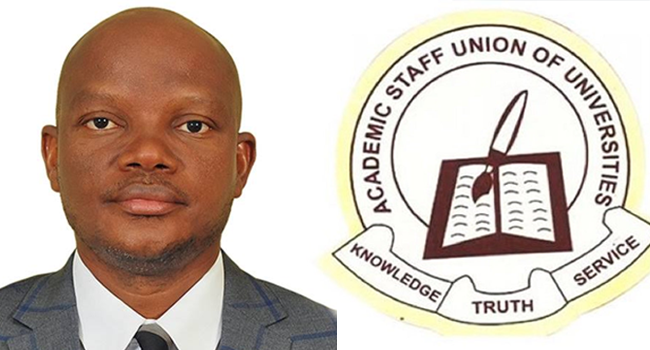
By Peter Omopo
Abuja, Nigeria | The Academic Staff Union of Universities (ASUU) has issued a stern warning to the Federal Government to resolve all lingering issues affecting the nation’s public universities within the next ten days or risk an immediate resumption of industrial action.
This warning comes as the one-month grace period granted by the union — following the suspension of its two-week warning strike on October 22 — is set to expire on November 22.
The decision was part of the resolutions reached at ASUU’s National Executive Council (NEC) meeting held at Taraba State University, Jalingo, between November 8 and 9. The outcome was contained in a statement released on Wednesday by ASUU President, Prof. Chris Piwuna.
According to the statement, the union accused certain government officials of sabotaging the negotiation process through misleading public statements about the government’s offers and the implementation status of earlier agreements.
“ASUU NEC regretted that government functionaries are undermining the negotiation process by subtly misrepresenting its offers and the implementation of agreements,” Piwuna said.
“Part payment of promotion arrears dating back to 2017 and the release of third-party deductions are mere confidence-boosting exercises and must not be framed as substantial progress.”
The union’s demands include a comprehensive review of the 2009 ASUU–Federal Government Agreement, payment of outstanding salaries and earned allowances, and the release of the university revitalisation fund.
ASUU warned that it would not hesitate to resume strike action without further notice if meaningful progress was not made before the expiration of the one-month window.
While acknowledging some progress in non-monetary aspects of the negotiations, the union insisted that the government’s proposed salary structure was “grossly inadequate” and incapable of addressing the brain drain in Nigeria’s tertiary education system.
“The government’s proposed salary offer is a mere drop in the ocean. It cannot reverse the brain drain syndrome that has plagued our universities for decades,” the statement read.
“Education must be seen as a social good and not a commercial venture. The failure to prioritise education is a clear sign of misplaced national priorities.”
ASUU also dismissed the Federal Government’s claim of insufficient funds, citing revenue growth at both federal and state levels. According to data quoted from the Federation Accounts Allocation Committee (FAAC), federal allocations rose from ₦3.42 trillion in 2022 to ₦4.65 trillion in 2024 — a 70 percent increase.
“It is the lack of political will, not lack of funds, that is undermining the resolution of this crisis,” Piwuna stated.
The union appealed to traditional rulers, opinion leaders, civil society organisations, the Nigeria Labour Congress (NLC), and students to continue exerting pressure on the government to meet its commitments and provide Nigerian lecturers with a living wage.
With less than two weeks remaining before the deadline, observers fear that another disruption to the academic calendar may be imminent unless swift action is taken to meet ASUU’s core demands.
