

By Peter Omopo
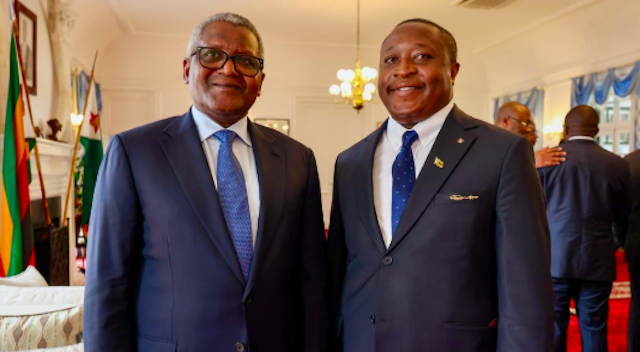
Africa’s richest man and President of the Dangote Group, Aliko Dangote, has announced plans to invest up to $1 billion in Zimbabwe for the development of cement and power plants, as well as a fuel pipeline, in a major boost to the southern African nation’s industrial and energy sectors.
According to Bloomberg, Dangote made the announcement in Harare after meeting with Zimbabwean President Emmerson Mnangagwa on Wednesday. The Nigerian billionaire expressed optimism about Zimbabwe’s economic prospects under Mnangagwa’s leadership.
“President Mnangagwa has turned the economy around. That really gave us the confidence that this is the right time for us to come and invest,” Dangote said.
Videos shared by Zanu PF Celebs Official, a Zimbabwean media outlet, showed Dangote’s arrival at the State House, where he was received by the Presidential Special Advisor on Investment, Dr. Paul Tempter Tungwarara. The post described the meeting as an engagement aimed at “strengthening investment cooperation and accelerating Zimbabwe’s economic development agenda.”
Expanding African Industrial Footprint
Sources close to the Zimbabwean government revealed that discussions between Dangote and Mnangagwa focused on potential collaborations in cement production, coal mining, and power generation—sectors central to Zimbabwe’s industrial revival plan.
“The engagement underscores Zimbabwe’s drive to attract strategic investment by drawing on Dangote’s multi-billion-dollar industrial capacity and influence across Africa,” the agency stated.
This isn’t Dangote’s first attempt to invest in Zimbabwe. In 2015, the Dangote Group proposed a $400 million cement plant with a capacity of 1.5 million tonnes per year, but the deal fell through after protracted negotiations with then-President Robert Mugabe.
Growing Regional Presence
Dangote’s latest investment announcement comes on the heels of a series of ambitious expansions across Africa. In August 2025, he signed a $2.4 billion deal to establish a fertiliser plant in Gode, Ethiopia, which broke ground in October. The project aims to harness Ethiopia’s natural gas reserves in the Hilal and Calub fields to drive agricultural growth, enhance food security, and create thousands of jobs across the Horn of Africa.
The Zimbabwe initiative, if realised, would not only strengthen Dangote’s industrial presence in southern Africa but also reinforce Zimbabwe’s efforts to attract foreign investment and stabilise its economy.
Observers say the move signals renewed investor confidence in Zimbabwe under Mnangagwa’s administration, which has prioritised energy sufficiency, infrastructure development, and manufacturing revival as key pillars of its economic reform agenda.
