

By Jimmy Fatunbi
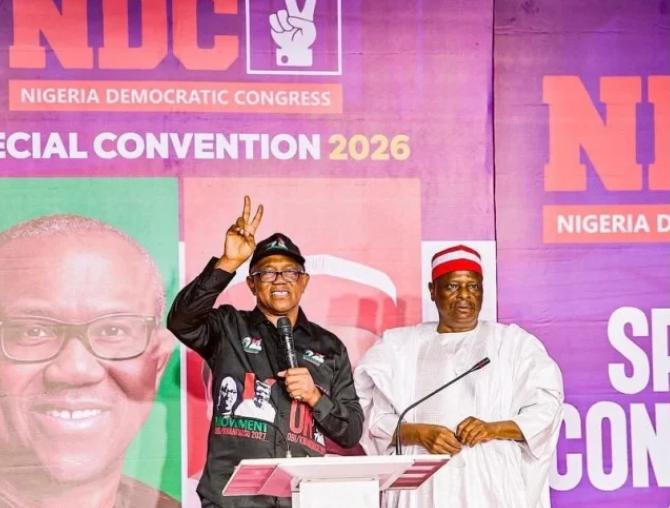
The presidential bid of former Anambra State governor, Peter Obi, and his running mate, Rabiu Kwankwaso, is drawing contrasting reactions across Northern Nigeria, with some political stakeholders questioning the alliance’s prospects while party supporters insist momentum is building ahead of the 2027 general election.
Investigations by Sunday PUNCH indicate that although the duo’s newly formed platform, the Nigeria Democratic Congress, has begun establishing structures in parts of the North, concerns remain over its visibility and acceptance among many voters in the region.
Some northern political leaders argued that the party is yet to gain widespread recognition, while others have reportedly cautioned supporters against embracing the platform. Political campaign materials circulating on social media in some northern communities have also portrayed the Obi-Kwankwaso alliance negatively.
The development follows reports that campaign posters bearing the images of Obi and Kwankwaso were destroyed by youths in Kano State’s Ungogo Local Government Area. In addition, Kano lawmaker Muhammad Tomas recently returned to the ruling party shortly after joining the NDC.
Party Yet to Gain Visibility — ACF
The National Publicity Secretary of the Arewa Consultative Forum, Prof. Tukur Muhammad-Baba, said the NDC remained largely unfamiliar to many northern voters.
According to him, while leading opposition figures continue to receive media attention, their electoral strength in the region remains uncertain.
He particularly questioned the extent of Kwankwaso’s influence beyond Kano State, noting that even his dominance in Kano could face fresh tests ahead of the next election cycle.
Muhammad-Baba added that frequent defections and shifting political alliances among politicians had contributed to voter uncertainty and scepticism.
He noted that many northerners were increasingly evaluating politicians based on performance rather than ethnic, regional or religious considerations.
According to him, growing dissatisfaction with the political class cuts across party lines, with citizens demanding practical solutions to economic and security challenges.
Questions Over Obi’s Northern Appeal
Similarly, President of the Arewa Youth Consultative Council, Zaid Ayuba, said Obi still faced trust-related challenges among some northern voters.
Ayuba claimed that perceptions surrounding Obi’s comments on the proscribed Indigenous People of Biafra had continued to generate debate in the region.
He argued that unless concerns regarding Obi’s position on the group were adequately addressed, gaining broad support in parts of Northern Nigeria could prove difficult.
Ayuba, however, stressed that his position was not based on ethnic or religious considerations but on what he described as issues of justice and national unity.
NDC Presence Still Limited, Says Academic
A political science professor in Sokoto State, who requested anonymity, also argued that the NDC currently lacks significant grassroots structures in many northern states.
According to the academic, the party remains less visible than established platforms such as the All Progressives Congress, Peoples Democratic Party and the African Democratic Congress.
He maintained that the challenge facing the party was more about visibility than outright rejection by voters.
Northern Youth Group Criticises Kwankwaso
The Northern Youth Assembly also criticised Kwankwaso for aligning with Obi, describing the move as inconsistent with what it termed the traditional values of the Kwankwasiyya political movement.
In a statement signed by its Secretary-General, Hafiz Garba, the group accused the former Kano governor of abandoning northern political interests and reducing the movement to an electoral vehicle.
Party Leaders Claim Growing Support
Despite the criticism, NDC officials and supporters insist the party is gaining traction across Northern Nigeria.
The party’s Borno State chairman, Haruna Amuda, said the NDC had witnessed a surge in membership, including defections from rival political parties. He added that structures had been established across all 27 local government areas of the state.
In Jigawa State, party chieftain Abdulrazak Birnin-Kudu said grassroots mobilisation was ongoing, with coordinators already appointed across local government areas.
The party’s governorship candidate in the state, Aminu Dutse, attributed growing interest in the NDC to economic hardship and insecurity, saying many voters were now looking for alternatives to the traditional political parties.
Alliance Has Strong Potential — Supporters
The Northern Region Director of the Civil Liberty Organisation, Steve Aluko-Daniel, dismissed claims that the party lacked acceptance in the North.
He argued that the region no longer possessed a unified political bloc following the departure of former president Muhammadu Buhari from active politics, allowing voters greater freedom to align with parties of their choice.
According to him, the Obi-Kwankwaso partnership is attracting support among voters seeking an alternative political direction.
Similarly, the National Co-Chairman of the NDC Coalition Alliance Network, Zakari Garba, described the alliance as one of the most formidable political combinations ahead of the 2027 election.
He said Obi’s reputation for economic management and accountability, combined with Kwankwaso’s extensive grassroots influence in the North, could provide the foundation for a competitive national campaign.
Efforts to obtain comments from the party’s Deputy National Publicity Secretary, Abdulmumin Abdulsalam, and the National Coordinator of the Obidient Movement, Yunusa Tanko, were unsuccessful as of the time of filing this report
