

By Peter Omopo
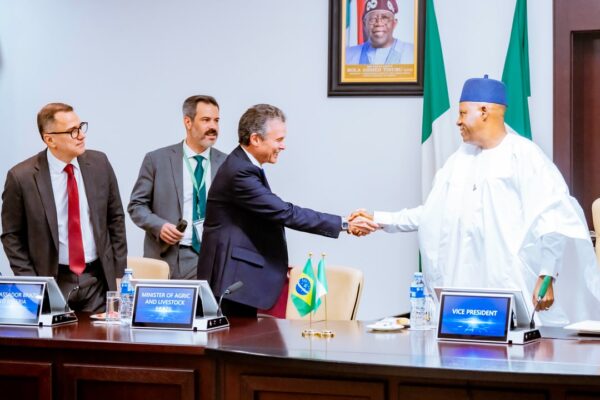
Vice President Kashim Shettima has announced that Nigeria and Brazil have moved beyond diplomatic engagements to the implementation phase of their bilateral agro-trade partnership, opening the door for increased agricultural trade and investment between both countries.
Shettima made the announcement during a high-level Nigeria-Brazil Agro-Trade Market Access Milestone meeting at the Presidential Villa in Abuja with a Brazilian delegation led by the country’s Minister of Agriculture and Livestock, André Carlos Alves de Paula Filho.
According to a statement issued by the Senior Special Assistant to the President on Media and Communications (Office of the Vice President), Stanley Nkwocha, the Vice President said the Nigeria-Brazil Agro-Trade Initiative had progressed from policy discussions to concrete implementation.
He noted that both countries had deliberately moved “from dialogue to delivery, from agreements to implementation, and from shared ambition to measurable outcomes,” adding that the development reflects the evolution of a sustainable bilateral partnership.
Shettima, who co-chairs the Nigeria-Brazil Strategic Dialogue Mechanism (SDM) alongside Brazil’s Vice President, Geraldo Alckmin, said the true value of international cooperation lies in delivering practical benefits to citizens.
He explained that the latest milestone builds on agreements reached during President Bola Tinubu’s state visit to Brazil and has laid the foundation for expanded trade, investment and technical cooperation in agriculture and livestock development.
According to the Vice President, the Joint Agriculture and Livestock Technical Working Group established under the Strategic Dialogue Mechanism is now fully operational, with specialised teams focusing on dairy and livestock genetics, soybean productivity, agricultural policy and agro-climatic risk zoning.
Recalling discussions between President Tinubu and Brazilian President Luiz Inácio Lula da Silva, Shettima said both leaders had recognised that agricultural trade between Nigeria and Brazil remained below its full potential and directed officials to identify opportunities to deepen collaboration.
He said the newly announced market access milestones are the result of months of coordinated efforts involving government ministries, regulatory agencies, technical experts and private sector stakeholders in both countries.
Shettima also commended the Brazilian government for strengthening its institutional presence in Nigeria through the appointment of an Agricultural Attaché and the increased participation of the Brazilian Agricultural Research Corporation (EMBRAPA), noting that both initiatives have accelerated technical cooperation.
He urged farmers, cooperatives, processors and exporters to take advantage of the emerging opportunities by meeting international standards, adding value to agricultural products locally and expanding Nigeria’s export capacity.
Speaking at the meeting, Brazil’s Minister of Agriculture and Livestock, André Carlos Alves de Paula Filho, said the two countries were making steady progress under the Nigeria-Brazil Accelerated Agricultural Trade Initiative established following agreements between Presidents Tinubu and Lula.
He disclosed that Brazil has agreed to grant market access for Nigerian exports of hibiscus, sesame and shea butter, revealing that Brazilian authorities are finalising the phytosanitary certification required to facilitate the exports.
The minister added that Brazil would also assist in linking Nigerian exporters with prospective Brazilian buyers to create commercial opportunities for the products.
Also speaking, Jigawa State Governor Umar Namadi welcomed the partnership, noting that the state contributes about 75 per cent of Nigeria’s non-oil exports and pledged support for the successful implementation of the initiative.
Minister of Agriculture and Food Security, Senator Abubakar Kyari, described Brazil as a global leader in agricultural transformation and expressed confidence that the renewed partnership would boost Nigeria’s agricultural exports while strengthening bilateral relations between the two countries.
