

By Peter Omopo
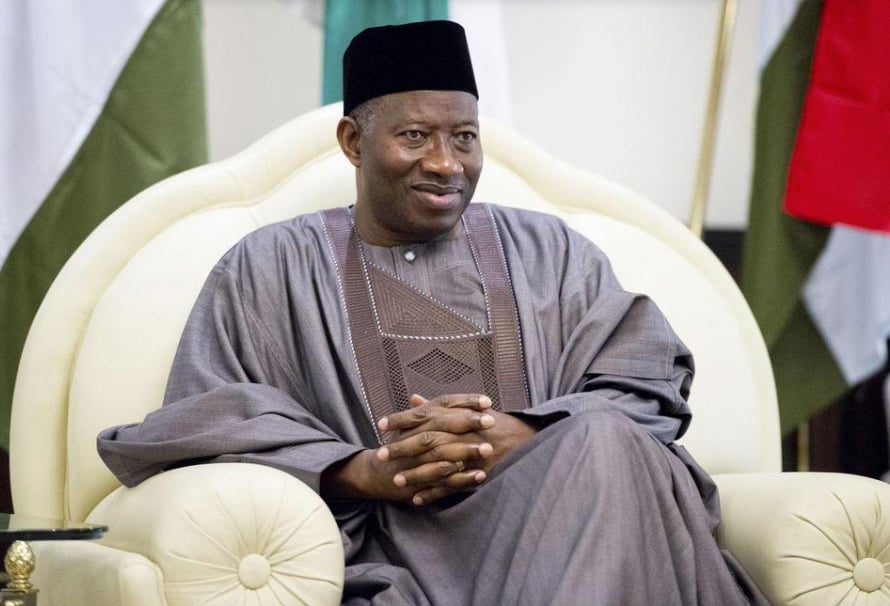
Former President Goodluck Jonathan has faulted persistent underdevelopment in the Niger Delta on entrenched personal interests, weak political will, and years of political rivalry among regional leaders.
Jonathan spoke in Abuja on Friday at the public presentation of The Hidden Treasures, a 202-page book authored by former Delta State governorship aspirant Chris Iyovwaye. The event also featured prominent political figures, including former Social Democratic Party presidential candidate Adewole Adebayo and ex-Minister of Information Prof. Jerry Gana, who echoed concerns over the region’s stalled progress.
Represented by his Chief of Staff, Mike Oghiadomhe, Jonathan said numerous development plans for the oil-rich region had failed because individual ambitions consistently overshadowed collective interest.
‘Power Struggle Stalled Progress’ — Jonathan
The former president recalled multiple attempts to forge a unified development front among South-South governors and federal lawmakers during his years as deputy governor of Bayelsa State between 1999 and 2007.
He noted that although strategic commissions and meetings were established, meaningful action was repeatedly undermined by power struggles.
“At one point, everybody in the Niger Delta wanted to be the vice president to an unknown president,” Jonathan said. “The competition for power and control of regional commissions made it impossible to take action. Ideas remained mere potential.”
He argued that the region’s enormous natural and economic potential — which he described metaphorically as “gold, diamonds, and uranium buried beneath” — would continue to amount to nothing without political cohesion and practical implementation.
Jonathan urged current South-South governors to pursue concrete, coordinated development plans, warning that rhetoric without political will would continue to hinder progress.
‘Niger Delta Should Be Nigeria’s Economic Hub’
The former president emphasized that the region is strategically positioned to become Nigeria’s major economic gateway, capable of hosting the country’s biggest seaport and connecting easily to the Middle Belt and northern regions.
He called for the creation of a strong investment vehicle to identify regional opportunities and drive projects across Niger Delta states.
Adebayo: ‘Niger Delta Is Too Rich for Its People to Be Poor’
Also speaking, former SDP presidential candidate Adewole Adebayo described the Niger Delta as a “mismanaged paradise,” arguing that no resident of the region should live in poverty given its abundant natural resources.
“If there is no Niger Delta, there is no Nigeria,” Adebayo said. “It is an oxymoron to say anyone from the Niger Delta is poor. The region is brimming with liquid, solid, human, and material resources.”
He criticised what he termed “blind leadership,” saying leaders who prioritised personal gain over long-term development had deprived the region of transformative growth.
Adebayo urged Niger Delta leaders to abandon practices that enable foreign exploitation of local resources in exchange for short-term political or economic benefits.
Gana: NDDC Has Not Delivered Its Founding Vision
Former Minister of Information Prof. Jerry Gana, who played a central role in conceptualising the Niger Delta Development Commission (NDDC) in 1999, lamented that the commission had drifted far from its original mandate.
He recalled that the NDDC was proposed as a major platform to deliver large-scale infrastructure across the region.
“But I must confess that despite the tremendous hope that the meeting generated, I have not been impressed by the results,” Gana said. “The commission was meant to transform the Niger Delta into one of the most beautiful places in Nigeria, not to build minor projects like primary schools.”
He urged the current NDDC leadership to “arise and do something great” to reverse decades of neglect.
Persistent Challenges
Despite being Nigeria’s main oil-producing region, the Niger Delta continues to struggle with:
- Widespread environmental degradation
- Poverty and unemployment
- Oil spills and gas flaring
- Infrastructural decay
- Conflicts over resource control
- Weak regulatory and governance structures
Multiple audits of the NDDC have revealed systemic corruption, abandoned projects, and diversion of funds—issues that have contributed to the region’s slow development.
Jonathan and other speakers called for renewed leadership and decisive action to unlock the region’s economic potential and improve the welfare of its people.
