

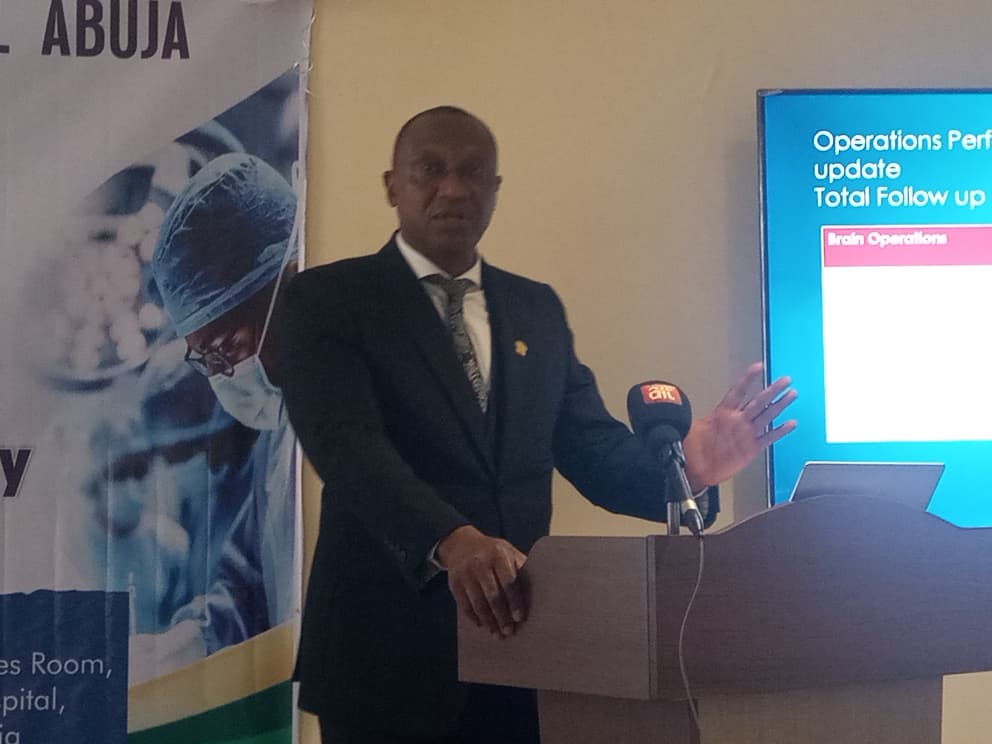
The Chief Consultant Neurosurgeon and Chief Executive Officer (CEO) of The Wellington Hospital for Neurology and Neurosurgery, Abuja, Dr Charles Ugwuanyi, has urged the
Federal Government to strengthen investment in specialised healthcare institutions as he disclosed that Nigeria loses an estimated $2 billion annually to medical tourism
Ugwuanyi made the disclosure on Monday at a press conference to commemorate the 15th anniversary of the establishment of the Wellington Hospital for Neurology and Neurosurgery in Abuja.
He said the persistent outflow of foreign exchange to pay for medical treatment abroad underscored the need for greater government support for high-end specialist hospitals capable of providing advanced medical services within the country.
According to him, Nigeria could retain a substantial amount of the money currently spent on overseas treatment by expanding the capacity of domestic healthcare institutions to handle complex medical procedures.
Highlighting the hospital’s contribution to specialist medical services, Ugwuanyi said it had performed thousands of complicated operations, demonstrating the potential of local institutions to reduce the country’s dependence on foreign healthcare facilities.
He said: “You can imagine, all these high-end operations, we have completed 2,450 complex brain operations, 2,500 complex operations. If all these people have worked outside this country, those who can afford, not all of them can afford, right? So, you can see how much capital flies.”
The neurosurgeon maintained that the financial implications of medical tourism extended beyond individual patients and their families, as the money spent abroad represented capital that could otherwise support domestic investment, medical infrastructure and specialised healthcare delivery.
He called on journalists to help draw public attention to the economic consequences of the trend and communicate to the government the importance of sustaining and expanding specialist hospitals.
“We will need the support of journalist to carry this message out there, especially to tell the government that they must support high-end special hospitals like this, and several others, in order to contribute their own quota towards halting the excessive hemorrhage of foreign exchange out of this country.”
Ugwuanyi added that the Wellington Hospital itself had contributed to the retention of capital within Nigeria by providing advanced medical services locally, rather than leaving patients who could afford such procedures with no option but to seek treatment overseas.
He said the institution’s experience over the past 15 years had reinforced the need to consolidate its achievements while working towards a healthcare system capable of meeting the needs of a growing population.
Reflecting on the hospital’s future, the chief executive said its next phase would require sustained efforts, stronger institutional capacity and cooperation among healthcare providers, the media and the government.
“So, where are we coming from? This is our offer. What does the future hold for us at the Wellington Institute? Well, the future starts today. We must consolidate.”
He stressed that responsible journalism and government support would be essential to sustaining the hospital’s work and advancing the broader objective of making specialised healthcare more accessible within Nigeria.
“We need the support of responsible journalism to sustain the focus of what we are doing today. We need the support of the government to sustain what we are doing today. Because, it is very clear to us that our set mandates, that means from the onset, we haven’t actualized it.”
Ugwuanyi explained that the hospital’s founding ambition was to help create a situation in which Nigerians would no longer need to travel abroad for critical medical procedures that could be performed safely and effectively at home.
He specifically cited cancer treatment, laser surgery for prostate conditions and kidney transplantation as areas in which the country should strive to develop sufficient local capacity to reduce the need for overseas medical care.
“Yes, because from the onset, we want a situation whereby nobody will leave this country to go and do treatment for cancer. Nobody should leave this country to go and do any laser surgery for prostate. Nobody should leave this country to go and do kidney transplant.”
Acknowledging that Nigeria’s healthcare system still faced significant challenges, the neurosurgeon argued that the solution lay in strengthening domestic institutions and improving the system rather than relying indefinitely on foreign destinations for advanced treatment.
He said the task was particularly urgent given the country’s expanding population, which he put at nearly 240 million, noting that healthcare planning and investment must be driven by Nigerians themselves to ensure that the system could adequately serve the population.
“Whatever the issues are, our systems are not perfect yet, but we must stay back here, make the system work, for not just us, but for an expanding population of nearly 240 million people. Nobody will freeze this country for us, except us.”
He urged stakeholders to sustain efforts to improve local healthcare delivery, insisting that stronger specialist institutions would be crucial to reducing medical tourism, retaining foreign exchange and building a healthcare system capable of meeting more of Nigerians’ needs at home.
