

By Peter Omopo
Since its historic commissioning on May 22, 2023, the Dangote Petroleum Refinery in Ibeju-Lekki, Lagos, has remained at the centre of intense industrial, regulatory and labour disputes, underscoring the challenges confronting Nigeria’s push toward energy self-sufficiency.
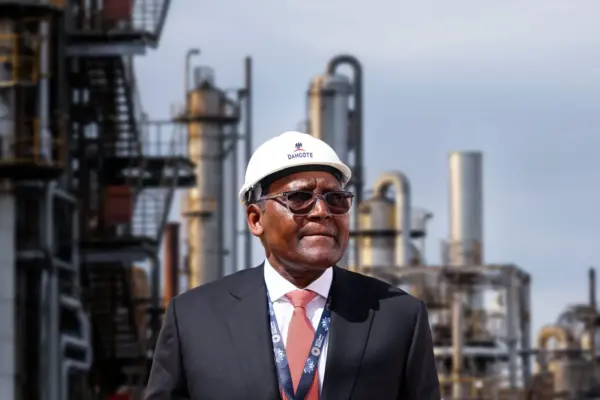
Owned by Africa’s richest man, Aliko Dangote, the $20 billion facility was designed to process 650,000 barrels of crude oil per day, end Nigeria’s dependence on imported fuel and produce Euro-V quality petroleum products for domestic and regional markets. Despite its scale and promise, the world’s largest single-train refinery has faced a series of controversies spanning product quality, pricing, crude supply, labour relations and regulatory oversight.
The refinery, which also includes a deep seaport, power plant and fertiliser unit, is expected to generate thousands of jobs and significantly boost Nigeria’s economy. However, what was initially projected as a smooth transition toward energy independence has instead evolved into a prolonged battle with stakeholders across the petroleum value chain.
One of the earliest controversies surrounded allegations of high sulphur content in diesel produced by the refinery. The issue gained prominence in 2024 following comments by the Chief Executive Officer of the Nigerian Midstream and Downstream Petroleum Regulatory Authority (NMDPRA), Farouk Ahmed, who questioned the quality of diesel from Dangote and some modular refineries.
Ahmed alleged that while imported diesel met the West African sulphur limit of 50 parts per million (ppm), diesel from Dangote Refinery ranged between 650 and 1,200 ppm, describing it as inferior. The refinery and petroleum marketers, however, disputed the claims, insisting that consumers had raised no complaints about the product.
The National President of the Independent Petroleum Marketers Association of Nigeria (IPMAN), Abubakar Maigandi, said transporters, motorists and industrial users had not reported any issues since the product entered the market. A senior official of the Dangote Group also dismissed the sulphur claims as false, attributing them to individuals allegedly determined to undermine the refinery.
Labour relations soon emerged as another flashpoint. In September 2025, the refinery announced a major reorganisation of its workforce following reported cases of sabotage that posed safety risks to its petrochemical operations. In a letter signed by the Chief General Manager, Human Asset Management, Femi Adekunle, management said the restructuring was necessitated by repeated incidents of sabotage across several units.
The exercise led to the disengagement of several workers, including senior staff, triggering a nationwide backlash from the Petroleum and Natural Gas Senior Staff Association of Nigeria (PENGASSAN). The union accused the refinery of violating labour rights and alleged that over 800 Nigerian workers were replaced with more than 2,000 foreign nationals.
PENGASSAN described the development as “enslavement of Nigerian workers” and embarked on a nationwide withdrawal of services, escalating tensions between organised labour and the refinery.
Another major dispute followed the refinery’s plan to procure over 4,000 compressed natural gas (CNG) trucks to enable direct distribution of petroleum products nationwide. The initiative, aimed at reducing logistics costs and lowering pump prices, was criticised by the National Union of Petroleum and Natural Gas Workers (NUPENG), which accused the refinery of attempting to sideline tanker drivers.
Protests by tanker drivers, including members of NUPENG, disrupted operations at the refinery and depots, leading to traffic congestion and clashes with security agencies.
At the same time, tensions flared between Dangote Refinery and the Depot and Petroleum Products Marketers Association of Nigeria (DAPPMAN) over logistics and pricing. The refinery accused DAPPMAN of demanding subsidised fuel prices to cover coastal transportation costs, a move it said would add N75 per litre to consumer prices and amount to an annual cost of N1.505 trillion.
DAPPMAN denied the allegations and issued a seven-day ultimatum demanding a retraction or legal action. The refinery, however, stood by its claims, stating that marketers were seeking discounts to enable them sell at the same price as the refinery’s gantry rate while using more expensive coastal logistics.
Dangote Refinery maintained that absorbing such costs would ultimately burden consumers and undermine pricing transparency in the downstream sector.
Crude oil supply has also posed a significant challenge. The refinery has repeatedly complained that the Federal Government, through the Nigerian National Petroleum Company Limited (NNPCL), has failed to meet agreed crude supply targets under the naira-for-crude initiative.
According to Dangote Industries Limited Vice President, Devakumar Edwin, the refinery requires 650,000 barrels per day but has not received the minimum 385,000 barrels per day earlier agreed with NNPCL. He described the volume supplied so far as inadequate to ramp up production, a claim reported by Reuters.
Regulatory tensions reached a peak recently when Aliko Dangote publicly accused the former NMDPRA chief executive, Farouk Ahmed, of allegedly paying about $5 million for the secondary school education of his four children in Switzerland. Dangote questioned how such expenditure could be funded from public service income and called for a full investigation by relevant authorities.
The allegations intensified scrutiny of the petroleum regulator and coincided with major leadership changes ordered by President Bola Ahmed Tinubu. The President subsequently requested Senate approval for new chief executives for both the NMDPRA and the Nigerian Upstream Petroleum Regulatory Commission (NUPRC), following the resignations of Farouk Ahmed and Gbenga Komolafe.
President Tinubu nominated Engineer Saidu Aliyu Mohammed as the new CEO of NMDPRA and Oritsemeyiwa Amanorisewo Eyesan as CEO of NUPRC, urging the Senate to expedite their confirmation.
As operations continue at the Dangote Petroleum Refinery, the series of disputes highlight the complex political, regulatory and economic terrain confronting Nigeria’s largest industrial project, even as expectations remain high that the facility will transform the country’s energy landscape.
