

By Peter Omopo
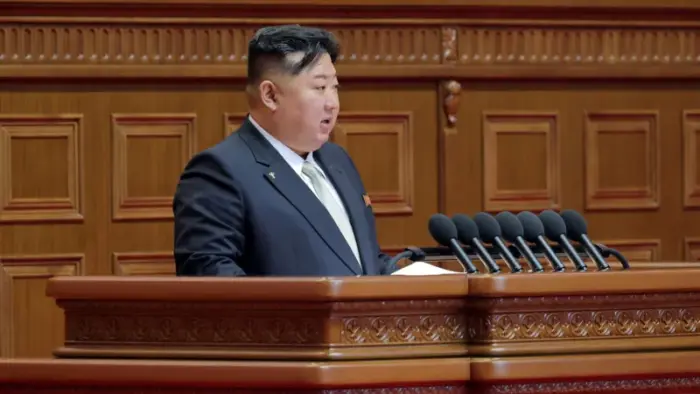
North Korean leader Kim Jong Un has been reaffirmed as General Secretary of the Workers’ Party of Korea, consolidating his hold on power as the country signals continued expansion of its weapons programme.
The announcement was made on Sunday during the party’s Ninth Congress in Pyongyang, a major political gathering widely viewed as a key indicator of North Korea’s future political and military direction.
State media reported that Kim’s reappointment was unanimous, reinforcing the dominance of the Kim family, which has governed the country since the late 1940s.
According to the state-run Korean Central News Agency (KCNA), North Korea has “radically improved” its war deterrence capabilities “with the nuclear forces as its pivot” under Kim’s leadership. The statement underscores Pyongyang’s sustained focus on nuclear weapons development despite years of international sanctions aimed at curbing its programme.
Since taking power in 2011 following the death of his father, Kim Jong Il, Kim Jong Un has accelerated the country’s nuclear and missile development, heightening tensions with Western nations, particularly the United States.
In the days preceding the congress, North Korea unveiled what it described as a range of nuclear-capable rocket launchers, raising expectations that Kim may outline further advancements in the weapons programme during the ongoing meeting.
The party congress, held every five years over the past decade, is regarded as North Korea’s most significant political event. With about 5,000 members reportedly in attendance, it offers rare insight into the country’s tightly controlled leadership structure and policy priorities, including economic management, foreign relations and defence strategy.
This year’s congress also featured internal leadership changes. State media indicated that more than half of the 39-member presidium, the party’s executive committee, has been replaced since the previous congress in 2021, signalling a reshuffle within the upper ranks of power.
In his opening address, Kim pledged to strengthen the struggling economy and improve living standards, describing them as “heavy and urgent historic tasks.” The remarks come as North Korea continues to face economic challenges stemming from sanctions and limited international trade.
Attention has also centred on Kim’s daughter, Ju Ae, amid speculation about succession planning. South Korea’s intelligence agency recently suggested she may have been identified as a potential heir. Believed to be about 13 years old, she has made several public appearances at high-profile state events, including missile inspections and a major military parade in Beijing.
The Beijing parade drew global attention as leaders of North Korea, China and Russia appeared together, a display widely interpreted as a signal of growing alignment among the three countries.
Chinese President Xi Jinping congratulated Kim on his reappointment, expressing willingness to strengthen bilateral ties and “write a new chapter” in China–North Korea relations, according to Chinese state media.
China remains North Korea’s largest trading partner and a critical source of economic support, although Beijing has occasionally voiced concern over Pyongyang’s expanding nuclear ambitions and its deepening ties with Russia.
