

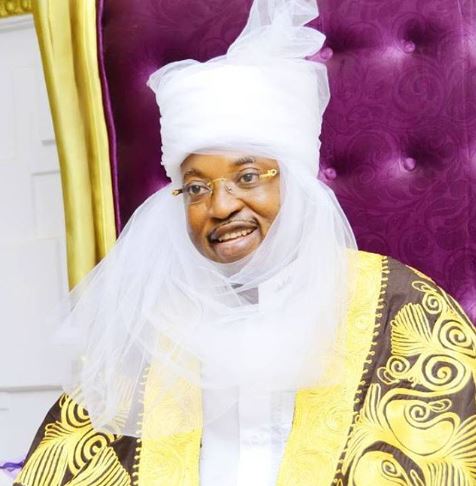
By Sola Ojewusi
Government warns of possible religious crisis and inter-town conflict, directs traditional ruler to desist from attacks on other faiths and fellow monarchs
The Osun State Government has placed the Oluwo of Iwo, Oba Abdulrosheed Akanbi, under close watch following concerns over what it described as inflammatory public statements capable of provoking religious tension, communal unrest and inter-town conflict.
In a strongly worded official communication, the state government cautioned the monarch against making utterances capable of undermining religious harmony, threatening the peace of neighbouring communities and bringing the traditional institution into disrepute.
The directives, contained in a letter issued by the Ministry of Local Government and Chieftaincy Affairs, Office of the Permanent Secretary, with reference number CD.17/1/VOL.VIII/377 and dated November 2026, reportedly warned that the government could no longer overlook the monarch’s alleged conduct in view of its potential implications for public peace and communal stability.
The letter, signed by Wale Alliyu on behalf of the Permanent Secretary, was addressed to the Oluwo and also copied to the Ooni of Ife, Oba Adeyeye Enitan Ogunwusi, in his capacity as Chairman of the Osun State Council of Obas.
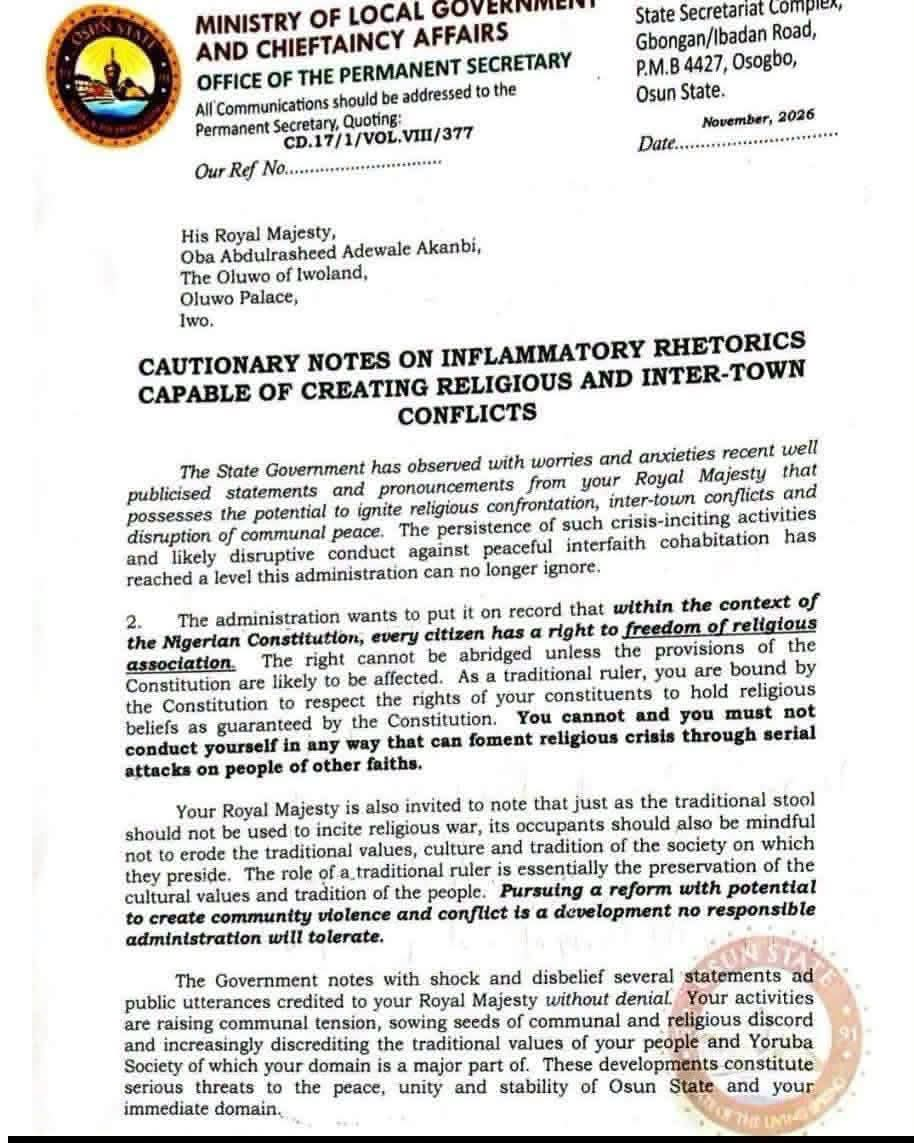
According to the government, it had observed several widely publicised statements and pronouncements attributed to the Oluwo which, in its assessment, could ignite religious confrontation, inter-town disagreements and a breakdown of communal peace.
The government expressed concern that the monarch’s activities were raising communal tension, sowing seeds of religious and social discord and increasingly discrediting the cultural values of his immediate constituency and the wider Yoruba society.
It maintained that the traditional institution should serve as a rallying point for unity, cultural preservation and peaceful coexistence rather than become an instrument for promoting religious antagonism or inter-community rivalry.
The government further reminded the Oluwo that religious freedom is constitutionally guaranteed to every Nigerian, irrespective of personal belief or religious affiliation. It stressed that the monarch, like every other citizen, is bound to respect the rights of his subjects to practise the religion of their choice.
While acknowledging the importance of traditional rulers in preserving indigenous institutions, customs and cultural heritage, the administration warned that any attempt to pursue cultural or religious reforms capable of provoking violence and communal confrontation would not be tolerated.
THE SIX ORDERS ISSUED TO THE OLUWO
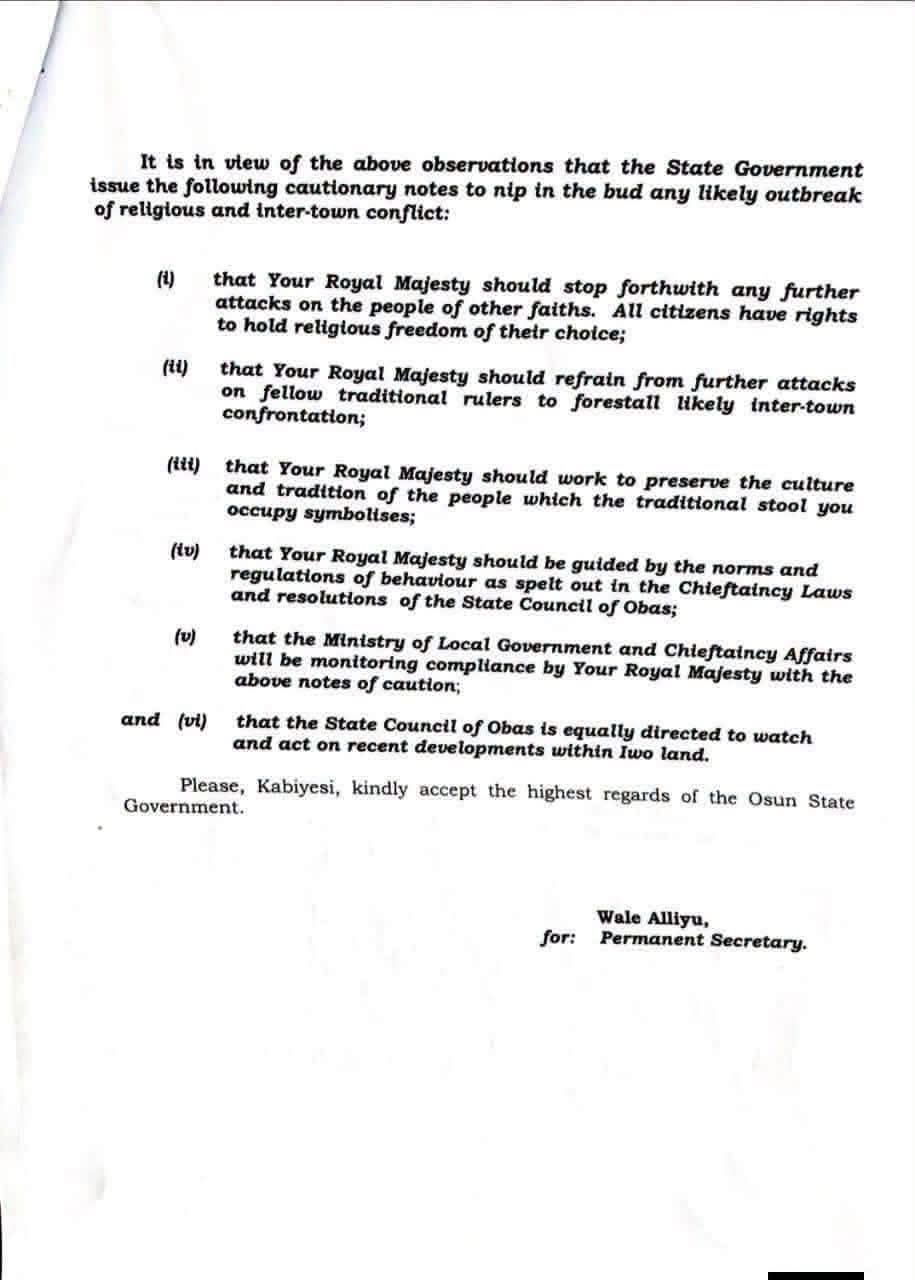
The Osun State Government outlined six specific directives which the Oluwo is expected to observe:
1. Stop attacks on people of other faiths.
The monarch was directed to immediately desist from further attacks, verbal or otherwise, against people belonging to religious groups other than his own. The government emphasised that every citizen has the constitutional right to freedom of religion and association.
2. Stop attacks on fellow traditional rulers.
The Oluwo was cautioned against further public attacks on other traditional rulers, particularly where such utterances could provoke hostility, deepen disagreements between traditional domains or trigger inter-town confrontation.
3. Preserve Yoruba culture and tradition.
The monarch was directed to concentrate on preserving the cultural heritage, customs and traditions of his people, which the traditional stool represents, rather than engage in activities capable of undermining the institution.
4. Comply with Chieftaincy Laws and State Council of Obas regulations.
The government instructed the Oluwo to be guided by the established norms, regulations and standards of conduct prescribed under the relevant Chieftaincy Laws and resolutions of the Osun State Council of Obas.
5. Submit to government monitoring.
The Ministry of Local Government and Chieftaincy Affairs announced that it would monitor the monarch’s conduct and compliance with the six cautionary directives, effectively placing his public activities under official scrutiny.
6. Allow the State Council of Obas to monitor developments in Iwo.
The State Council of Obas was equally directed to watch developments within Iwo land and take appropriate action in response to emerging concerns.
THE CONTROVERSIAL UTTERANCES
Although the government did not specifically identify every statement or incident that informed its decision, the report noted that the Oluwo had repeatedly used his social media platforms to criticise certain practices among Yoruba traditional rulers, particularly those associated with traditional religious beliefs and coronation rites.
In a video published on his Facebook page on July 1, Oba Akanbi reportedly described traditional rites and the seclusion of newly installed monarchs as undesirable practices, alleging that they could become avenues for enslaving traditional rulers and drawing them into idolatry.
In another video shared on October 10, the monarch questioned the authenticity and significance attached to ancient crowns, arguing that crowns were essentially products of the monarchs who wore them.
These public interventions have apparently attracted the attention of the state government, which considers the wider implications of such pronouncements for religious harmony, the dignity of the traditional institution and relationships among Yoruba monarchs.
WHAT HAPPENS IF THE OLUWO IGNORES THE GOVERNMENT’S ORDERS?
The implications of the Oluwo’s possible refusal to comply with the directives could be far-reaching, particularly because the government has moved beyond issuing a general appeal for restraint to formally documenting its concerns and announcing an official monitoring mechanism.
First, continued inflammatory statements, if established, could provide grounds for further disciplinary proceedings under the applicable Osun State Chieftaincy Laws and regulations. Depending on the specific statutory provisions and the procedures required by law, such proceedings could result in a formal query, investigation, suspension or other disciplinary measures against the monarch. Any such action would, however, have to be supported by the relevant law and due process.
Second, persistent attacks on fellow traditional rulers could worsen relations between Iwo and other traditional communities. In a region where traditional institutions remain important symbols of identity, authority and communal allegiance, a prolonged disagreement involving prominent monarchs could generate hostility among their respective subjects and potentially undermine longstanding inter-town relationships.
Third, continued religiously provocative pronouncements could expose the monarch to greater scrutiny by security agencies, especially if credible evidence emerges that his statements have contributed to threats, incitement, public disorder or acts of violence. Depending on the circumstances, relevant provisions of criminal law could become applicable. Mere criticism of religious practices, however, does not automatically constitute a criminal offence.
Fourth, failure to comply could undermine the Oluwo’s standing within the Osun State Council of Obas and weaken his relationship with other traditional rulers. The Council’s involvement is particularly significant because the government has expressly directed it to monitor developments in Iwo land.
Perhaps more importantly, the government could interpret persistent disregard for its directives as a challenge to its authority over chieftaincy administration and the maintenance of public order. This could prompt a more decisive institutional response, provided the government acts within its statutory powers.
Ultimately, the unfolding situation presents the Oluwo with an important opportunity to demonstrate that the authority and dignity of the traditional stool can coexist with religious tolerance, cultural preservation and respect for other traditional institutions.
The central issue is not whether a traditional ruler is entitled to express his personal religious convictions or advocate reforms within his domain. Rather, it is whether such expressions can be made without infringing on the constitutional rights of others, provoking communal hostility or diminishing the collective dignity of the traditional institution.
For Osun State, the challenge will be to enforce its directives impartially, without appearing to suppress legitimate religious expression or criticism of traditional practices. For the Oluwo, the immediate test will be whether he chooses restraint and dialogue or continues along a path that could bring his throne into a potentially prolonged confrontation with the state government and other traditional institutions.
The consequences of a prolonged confrontation may therefore extend beyond the palace in Iwo. They could affect the stability of the traditional institution, religious coexistence, inter-town relations and the wider peace of Osun State.
