

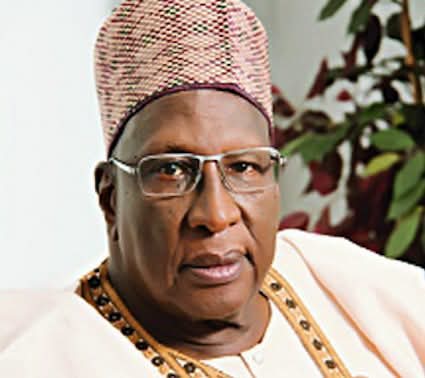
By Sola Ojewusi
The death of Alhaji Bamanga Muhammad Tukur at the age of 90 has removed from Nigeria’s political and economic landscape one of the few men whose public career traversed several defining eras of the nation’s post-independence history.
From public administration and the management of Nigeria’s ports to elective politics, state governance, federal ministerial office, private enterprise and the leadership of major African business organisations, Tukur’s career reflected the changing fortunes and aspirations of Nigeria and the African continent over more than five decades.
President Bola Ahmed Tinubu, in mourning the elder statesman, described his passing as the end of “a remarkable chapter in Nigeria’s political and economic history.”
That description captures the breadth of a career that was considerably larger than any single political office he occupied.
Born on September 15, 1935, Bamanga Tukur emerged from Adamawa into national prominence at a time when Nigeria was still developing the institutions and leadership structures of a newly independent country. He would eventually become one of the prominent sons of the old Northern region and, later, one of the most recognisable political and business figures from Adamawa.
He was known traditionally as the Tafidan Adamawa, a title that reflected his standing within the Adamawa Emirate and his importance in the social and political life of the state.
But Tukur’s influence was not confined to traditional authority or regional politics. His career was defined by a willingness to operate across institutional boundaries, moving between government, business, politics and international economic advocacy.
One of the earliest major milestones in his public career was his appointment as General Manager of the Nigerian Ports Authority in 1975.
The position placed him at the centre of one of Nigeria’s most strategically important economic institutions. The ports were, and remain, critical gateways for the nation’s international commerce, connecting Nigeria to global markets and supporting the movement of goods into and out of the country.
Between 1975 and 1982, Tukur was involved in efforts to modernise port operations and improve the efficiency of Nigeria’s maritime sector.
His years at the Nigerian Ports Authority established his reputation as an administrator capable of managing a large and strategically important public institution. They also gave him an understanding of logistics, trade and infrastructure that would later complement his activities in the private sector and African business community.
Tukur subsequently entered the turbulent world of Nigerian politics.
The Second Republic offered him the opportunity to translate his administrative experience into elective political leadership. In 1983, he was elected Governor of the old Gongola State.
At the time, Gongola was one of Nigeria’s large states, covering territory that would eventually become Adamawa and Taraba states. His governorship therefore belonged to an earlier phase of Nigeria’s state structure, before the extensive creation of additional states transformed the country’s political map.
His emergence as governor placed him among the political actors of the Second Republic, a period that remains significant in Nigeria’s democratic history because it represented the country’s return to civilian rule after years of military government.
The Second Republic, however, was short-lived. The military coup of December 1983 brought the democratic experiment to an abrupt end and returned the country to military rule.
Tukur’s career nevertheless continued.
Rather than disappearing from national life, he increasingly built his influence through business and economic leadership. In the private sector, he became Chairman of BHI Holdings and the DADDO Group of Companies.
The business interests associated with the groups extended across manufacturing, agriculture, logistics and trading, providing Tukur with another platform through which he could pursue his longstanding interest in economic development.
His movement between government and business reflected a philosophy that would become increasingly visible in his later African activities: that political sovereignty alone could not deliver prosperity without economic capacity, productive enterprise and strong private-sector participation.
That philosophy also informed his return to government at the federal level.
Between 1993 and 1995, during the administration of General Sani Abacha, Tukur served as Federal Minister of Industries.
The portfolio placed him at the heart of debates concerning Nigeria’s industrialisation, manufacturing capacity and economic development. It also reinforced the connection between his public-sector experience and his private-sector interests.
But perhaps one of the most enduring dimensions of Tukur’s legacy was his work beyond Nigeria.
At a time when the African continent was grappling with the consequences of economic dependency, weak intra-African trade and limited industrial capacity, Tukur became an outspoken advocate of a stronger African economic renaissance.
He served as Executive President of the African Business Roundtable and Chairman of the NEPAD Business Group.
Through these platforms, he championed the expansion of intra-African commerce and the development of an African economy driven increasingly by indigenous enterprise and private-sector investment.
His advocacy placed him within a generation of African business leaders who argued that the continent’s development could not depend exclusively on governments or foreign assistance.
For Tukur, African governments, businesses and institutions had to build the capacity to create wealth internally, expand trade among African countries and develop sustainable economic partnerships.
The emergence of the New Partnership for Africa’s Development, NEPAD, provided a particularly important platform for this philosophy.
Tukur’s involvement with the NEPAD Business Group reflected his conviction that the private sector should have a central role in implementing Africa’s development agenda.
His continental work consequently gave him a profile that extended beyond Nigeria’s political class. He became part of the broader conversation about Africa’s economic transformation and the role of African businesses in determining the continent’s future.
Yet Nigerian politics continued to exert a powerful pull on his career.
In March 2012, Tukur became National Chairman of the Peoples Democratic Party, Nigeria’s dominant political party at the time.
His emergence as chairman occurred during a period of considerable internal tension within the party and intense political competition across the country.
As national chairman, he sought to assert party discipline and strengthen the mechanisms for consensus within the organisation.
His tenure lasted until January 2014, when he stepped down amid growing internal disagreements within the party.
Despite the controversies that accompanied his period in office, Tukur’s place in Nigerian political history was already firmly established. He had participated in the country’s political life across multiple generations, from the Second Republic to the Fourth Republic.
Few Nigerian politicians could claim a comparable institutional journey.
He had been an administrator before becoming an elected governor; a governor before becoming a businessman; a businessman before returning to federal public office; a continental business leader before becoming national chairman of one of Nigeria’s largest political parties.
This breadth was central to the way President Tinubu remembered him.
According to the President, Tukur was “urbane, generous and deeply rooted in the values of integrity and service that the Adamawa Emirate and the nation hold dear.”
Tinubu also described him as “a man of big ideas and bold enterprise” who believed in Nigeria’s limitless potential.
The words are significant because Tukur’s career was ultimately characterised by the intersection of ideas and institutions.
He belonged to a generation that viewed national development through the prism of institution-building, public service and economic enterprise. His professional life moved through some of the institutions that were central to Nigeria’s development: the ports, state government, the federal Ministry of Industries, private-sector conglomerates and national and continental business organisations.
His political journey also mirrored Nigeria’s own difficult democratic trajectory.
He was part of the political generation that emerged during the Second Republic, witnessed the return of military rule, participated in governance under a military administration and later returned to partisan politics under the Fourth Republic.
In this respect, his life provides a window into the evolution of Nigeria’s political elite over the decades.
For Adamawa, however, his passing carries a particularly profound significance.
Tukur was not merely a former governor or national politician. As Tafidan Adamawa, he occupied an important place in the traditional and social hierarchy of the emirate. His influence extended into the state’s political, business and community affairs.
His death therefore represents the passing of one of the state’s most recognisable elder figures.
For the business community, his legacy is associated with the conviction that Nigerian enterprise could compete and contribute to national development.
For the political class, he represented a generation of politicians whose careers were shaped by the transition between military and civilian rule.
For the African business community, he was an advocate of stronger economic integration and greater private-sector participation in the continent’s development.
And for younger generations of Nigerians who encountered him primarily through his later political roles, his career provides a reminder of how dramatically the country’s political and economic institutions have evolved since independence.
President Tinubu has extended condolences to the Tukur family, the Fombina Emirate of Adamawa, the government and people of Adamawa State and the wider political and business communities in Nigeria and across Africa.
He prayed that Almighty Allah would forgive Tukur’s shortcomings, grant him Aljannah Firdaus and comfort those mourning his death.
With his passing, Nigeria loses more than a former governor, minister or political party chairman. It loses a witness and participant in several chapters of the country’s modern history.
Bamanga Tukur belonged to a generation that saw Nigeria move from the optimism of independence through military interventions, political upheavals, economic transformations and the eventual consolidation of the Fourth Republic.
He served, governed, built businesses, led political organisations and spoke for African enterprise.
His was, in the fullest sense, a life lived at the intersection of Nigeria’s public and private destinies.
And as the tributes begin to gather around his family, Adamawa and the nation, the measure of Bamanga Tukur’s legacy will ultimately rest not only in the offices he occupied, but also in the institutions he helped shape, the economic ideas he championed and the generations of Nigerians and Africans who encountered him in the long journey toward national and continental development.
At 90, the Tafidan Adamawa has departed.
But the chapter of Nigerian history in which he played so many roles will remain.
