

By Peter Omopo
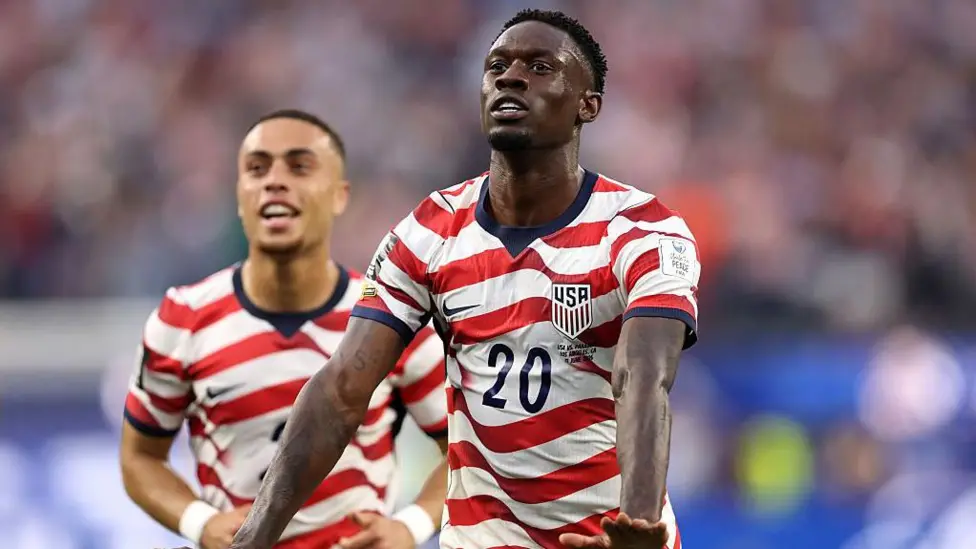
United States striker Folarin Balogun has emerged as one of the standout performers at the 2026 FIFA World Cup, but his remarkable journey to representing the United States has also drawn attention to the ongoing debate over birthright citizenship in the country.
Balogun announced himself on the global stage with a brace in the United States’ emphatic victory over Paraguay in their opening match of the tournament, further cementing his status as a key figure in the co-hosts’ World Cup campaign.
However, the 24-year-old forward’s eligibility to play for the United States stems from circumstances surrounding his birth. Born in Brooklyn, New York, on July 3, 2001, to Nigerian parents who were residing in London at the time, Balogun automatically acquired U.S. citizenship under the country’s birthright citizenship laws.
His story has gained renewed relevance amid legal and political debates surrounding President Donald Trump’s executive order seeking to restrict automatic citizenship for children born in the United States to parents who are either undocumented immigrants or temporary visa holders.
The issue is currently before the Supreme Court of the United States, which is expected to rule on the matter in the coming weeks.
Balogun, who developed through the youth ranks of Arsenal FC, was eligible to represent England, Nigeria, or the United States at international level. He initially featured for youth teams in both England and the United States before eventually committing his international future to the American national team in 2023.
His decision followed an extensive recruitment effort by U.S. Soccer officials after a prolific loan spell at French club Stade de Reims, which later earned him a move to AS Monaco
Balogun has since become a central figure for the U.S. national team, scoring 11 goals in 28 appearances and providing the attacking edge many supporters believe the team has long lacked.
Following his match-winning display against Paraguay, U.S. captain Christian Pulisic praised the striker’s influence, describing him as a lethal finisher whose form could be crucial to the team’s World Cup ambitions.
Former U.S. international Kenny Cooper also hailed Balogun as a proven goalscorer capable of helping the United States achieve a historic run at the tournament.
Beyond football, Balogun’s story has become intertwined with a broader national conversation about citizenship, immigration, and identity in America. Legal experts have noted that while the Trump administration has indicated it would not seek to revoke citizenship already granted under existing laws, the outcome of the Supreme Court case could have significant implications for future generations.
The debate has generated widespread public interest, with recent opinion polls indicating that a majority of Americans support maintaining automatic citizenship for children born on U.S. soil, although views remain sharply divided along political lines.
For many supporters, however, Balogun’s success embodies the multicultural identity that has long defined American society and sport. His rise has also reinforced the growing diversity within the U.S. national team, which features players from a wide range of cultural and ethnic backgrounds.
As the United States prepares for its next World Cup fixture against Australia, Balogun will once again be expected to lead the attack, with fans hopeful that his goals can propel the host nation deeper into the tournament.
Having already scored twice in the opening game, the former Arsenal academy product has quickly emerged as one of the early contenders for the tournament’s Golden Boot and one of the faces of the United States’ World Cup campaign.
