

By Peter Omopo
Barham Salih, a former Iraqi president and one-time refugee, has assumed office as the new head of the United Nations High Commissioner for Refugees (UNHCR), pledging to bring personal experience and renewed urgency to the global refugee crisis.
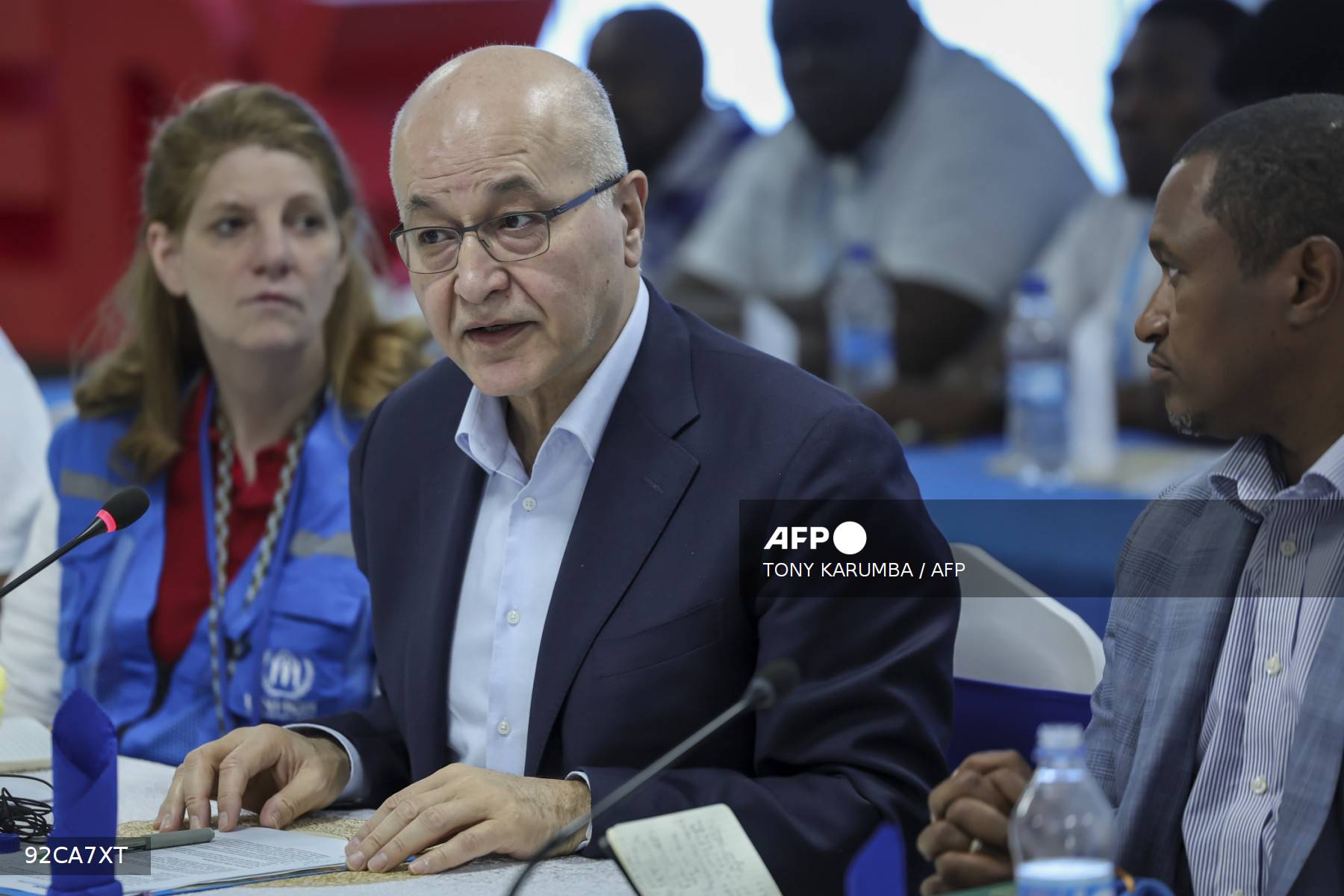
Salih, 65, became the first former head of state to lead the UN refugee agency at the start of the year. Speaking to AFP during his first official trip in the role to Kakuma refugee camp in Kenya, he said his own history of exile and persecution shaped his approach to the job.
“I know the pain of losing a home, losing your friends,” Salih said, describing the responsibility of leading UNHCR as both moral and legal.
Kakuma camp, which Salih visited on Sunday, is East Africa’s second-largest refugee settlement, hosting about 300,000 people from countries including South Sudan, Somalia, Uganda and Burundi. Established in 1992, the camp has become emblematic of protracted displacement.
Salih said the international community “should not allow this to continue,” while commending Kenya’s initiative to transform refugee camps into economic hubs. He stressed that beyond protection, refugees must be given access to durable solutions, while noting that lasting peace in countries of origin remains the ultimate goal.
“The better way is to have peace established in their own countries… nowhere is nicer than home,” he said.
Born in 1960 in Sulaymaniyah in northern Iraq, Salih is the son of a judge and a women’s rights activist. He went into exile in Iran in 1974 and later became involved with the Patriotic Union of Kurdistan (PUK). As a teenager in 1979, he was arrested twice by the regime of former Iraqi dictator Saddam Hussein and subjected to torture.
“I was released after 43 days after having suffered torture, electric shocks, beating,” he recalled.
Despite the ordeal, Salih excelled academically before fleeing to Britain with his family, where he earned a degree in computer engineering and a doctorate. He later returned to Iraq following the overthrow of Saddam Hussein in 2003 and went on to hold senior roles in both the Kurdistan Regional Government and Iraq’s federal administration, serving as president from 2018 to 2022.
His predecessor at UNHCR, Filippo Grandi, said Salih’s personal experience of exile gave him a vital perspective on displacement.
Meanwhile, Salih takes over the agency at a challenging time. UNHCR said global refugee numbers have doubled to 117 million over the past decade, while funding has declined sharply. The agency has faced significant budget cuts, particularly since the return of former US President Donald Trump to the White House.
UN Secretary-General Antonio Guterres recently highlighted Salih’s background as a crisis negotiator and reformer, noting that UNHCR is facing “very serious challenges.”
Acknowledging the constraints, Salih said staff numbers had been reduced following major budget cuts last year but stressed the need for adaptation.
“We have to understand, we have to adapt,” he said, calling for greater efficiency and accountability while urging the international community to meet its “legal and moral obligations” to refugees worldwide.
