

By Peter Omopo
Johannesburg, South Africa – Tensions escalated over the weekend between the United States and South Africa following a diplomatic dispute at the G20 Leaders’ Summit in Johannesburg, where the White House criticized Pretoria for what it described as a “weaponized” G20 presidency.
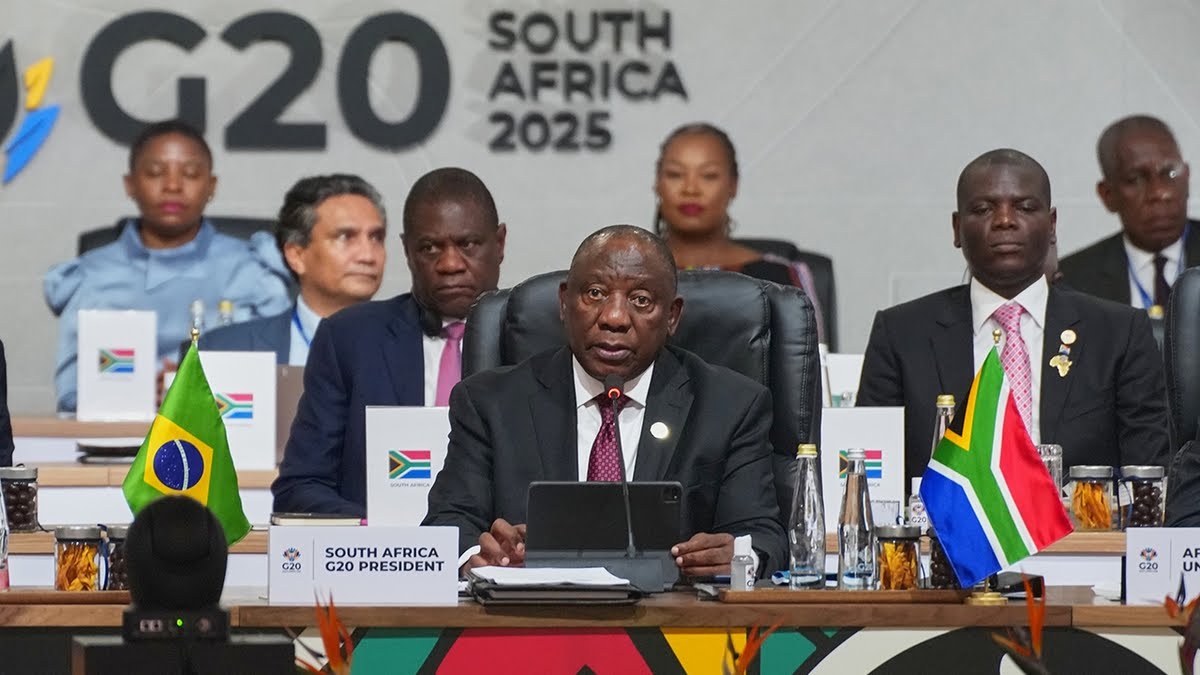
The row intensified after South Africa declined a U.S. request to have its chargé d’affaires represent Washington at the summit’s closing ceremony. President Cyril Ramaphosa’s office insisted that the ceremonial handover of the G20 presidency could not be done to a junior diplomat. The U.S. is scheduled to assume the G20 leadership in 2026.
White House Deputy Press Secretary Anna Kelly condemned the move, stating that South Africa’s actions undermined a peaceful transition of leadership.
“President Ramaphosa initially declared he would pass the gavel to an ‘empty chair.’ Now he’s refusing to facilitate a smooth transition at all,” Kelly said.
She also accused South Africa of pushing through a G20 Leaders’ Declaration despite “consistent and robust U.S. objections,” adding that the presidency had been “weaponized” to challenge the organization’s founding principles. She emphasized that President Donald Trump was committed to “restoring legitimacy” to the G20 in its next host year.
President Trump had previously withdrawn all U.S. participation in the summit, alleging discrimination against white South Africans.
South African Chief Rabbi Criticizes G20 for Silence on Christian Persecution
Meanwhile, South Africa’s Chief Rabbi, Dr. Warren Goldstein, criticized the G20 for failing to address what he described as widespread Christian persecution across Africa. Speaking exclusively to Fox News Digital, he questioned why the Leaders’ Declaration did not reference violent attacks against Christians in multiple countries.
“How can it be that the G20 ignores one of the continent’s greatest human rights crises—the continent-wide jihadi war on Christians?” Goldstein asked.
He pointed to recent attacks, including the kidnapping of more than 300 girls and 12 teachers from a Catholic school in Nigeria, calling the silence “a moral disgrace.”
Goldstein argued that Africa has become the “central front of Islamist terrorism,” citing violence in Mozambique, Mali, the DRC, Nigeria, Sudan, and others.
He warned that history would judge the G20 harshly for ignoring the crisis.
Of the 42 world leaders and organizations represented at the summit, only Italian Prime Minister Giorgia Meloni publicly condemned the attacks on Christian communities, issuing a statement urging the Nigerian government to increase protections.
Concerns Over G20 Declaration Adoption
Further controversy arose after President Ramaphosa was overheard—via an open microphone—telling leaders that the summit’s 122-point resolution was ready for endorsement before formal discussions had taken place. This fueled additional criticism from the U.S. regarding the legitimacy of the declaration.
South Africa officially marked the United States as “absent” from the summit. The only visible representation of the country was the American flag displayed in the media center.
The final declaration, released Sunday, made only a general reference to religion and condemned attacks against civilians, terrorism, and violations of sovereignty. No direct mention was made of Christian persecution.
The South African government has not responded to requests for comment.
