

By Peter Omopo | Abuja | October 9, 2025
The Federal Government of Nigeria has officially presented Judge Dr. Taoheed Elias as its candidate for election to the International Court of Justice (ICJ), appealing for international support to restore West Africa’s representation on the world’s highest judicial body.
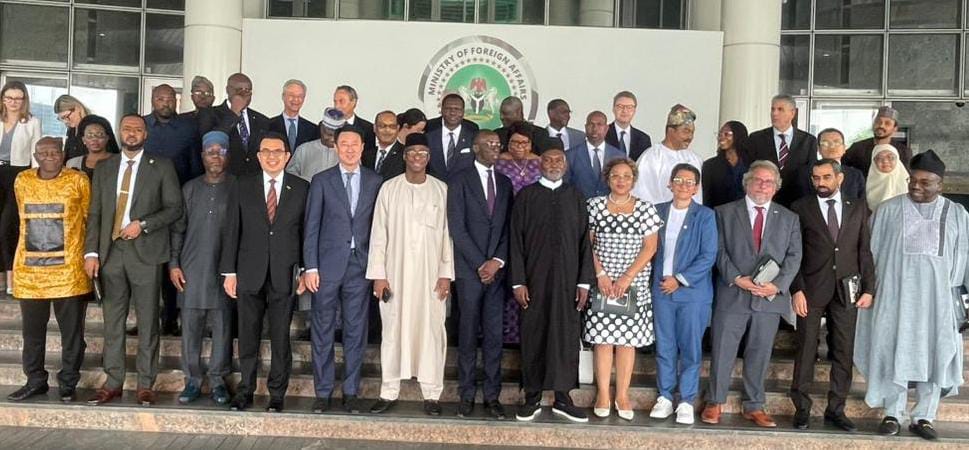
The formal presentation took place on Thursday in Abuja, bringing together senior government officials and members of the diplomatic corps. The Minister of Foreign Affairs, Ambassador Yusuf Tuggar, led the ceremony and called for global cooperation in supporting Dr. Elias’s candidacy.
Tuggar noted that West Africa has not had a representative on the ICJ since 2011, while Nigeria’s last appearance on the court dates back over three decades.
“This long absence is not a matter of pride but of perspective,” Tuggar said. “It underscores the importance of equitable geographical representation and the need for voices from West Africa to again be heard within the world’s highest judicial body.”
Describing Dr. Elias as “a candidate for the international community,” Tuggar highlighted his extensive experience and professional integrity, noting that he embodies the values of competence, moral character, and global service outlined in Article 2 of the ICJ Statute.
“He is a Nigerian national, a distinguished scholar, a seasoned international civil servant, and a respected judge,” Tuggar said. “Elias’s candidacy reflects the very ideals that unite us as members of the diplomatic community — integrity, competence, and commitment to justice.”
Addressing the audience, Dr. Elias expressed gratitude for the nomination and reaffirmed his commitment to the principles of international law and peaceful conflict resolution.
“The ICJ stands at the cornerstone of the entire architecture of the United Nations, being responsible for the peaceful resolution of disputes,” he said.
He outlined three pillars of his candidacy — academic expertise, institutional knowledge, and judicial experience — citing his over 20 years of service within the United Nations system and his current role as a judge ad hoc at the ICJ.
Elias explained that his selection as judge ad hoc by Equatorial Guinea, a country outside his nationality, underscores his reputation for fairness and competence.
“Equatorial Guinea didn’t pick somebody from their own country; they picked me,” he noted, describing it as a testament to his credibility.
He also acknowledged the legacy of Judge Abdulqawi Yusuf of Somalia, whose seat he is seeking to fill, and emphasized the need for broader perspectives on the ICJ bench.
If elected, Elias would become the fourth Nigerian to serve on the ICJ, following Charles Onyeama, Bola Ajibola, and his father, Taslim Olawale Elias, who also served as President of the Court.
Elections for the ICJ are scheduled for November 12, 2025, to fill the vacancy left by Judge Yusuf.
Dr. Elias, a member of the Institut de Droit International, has served as Legal Adviser and Director at the Organisation for the Prohibition of Chemical Weapons (OPCW) in The Hague. He currently serves as President of the Administrative Tribunal of the OPEC Fund for International Development, Chairman of the Islamic Development Bank Administrative Tribunal, and a former President of the OPEC Appeals Committee.
Established in 1945, the International Court of Justice, headquartered in The Hague, Netherlands, serves as the principal judicial organ of the United Nations, tasked with resolving disputes between sovereign states and interpreting international law.
