

By Peter Omopo
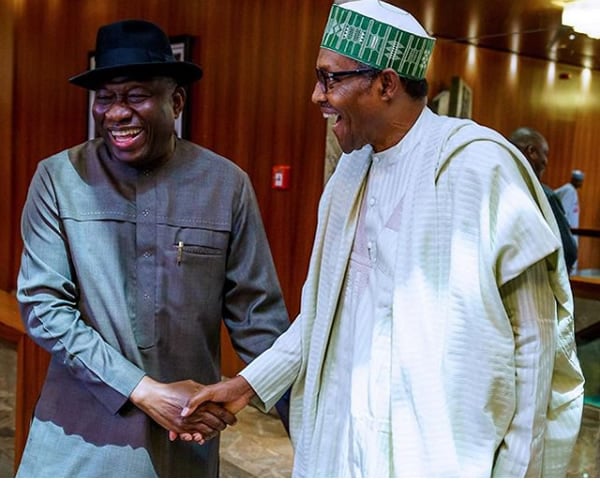
October 3, 2025 | Abuja – Former President Goodluck Jonathan has disclosed that Boko Haram insurgents once nominated his successor, Muhammadu Buhari, to represent them in peace talks with the Federal Government.
Jonathan made the revelation on Friday in Abuja during the public presentation of Scars, a book authored by former Chief of Defence Staff, General Lucky Irabor (retd.).
According to him, while in office, his administration established several committees to explore dialogue with the sect. In one of such efforts, the insurgents named Buhari as their preferred negotiator.
“One of the committees we set up then, the Boko Haram nominated Buhari to lead their team to negotiate with the government,” Jonathan said. “So, I was feeling that if they nominated Buhari to represent them and have a discussion with the government committee, then when Buhari took over, it could have been an easy way to negotiate with them and they would have handed over their guns. But it was still there till today.”
Jonathan stressed that the failure to end the crisis even after Buhari assumed power showed that the insurgency was more complex than often portrayed. He recalled that Boko Haram emerged in 2009 when he was vice president and escalated after he became president in 2010. Despite multiple strategies during his five years in office, he admitted the group remained a formidable threat.
“I thought that after I left, within a reasonable time, General Buhari would wipe them out. But even today, Boko Haram is still there. The issue of Boko Haram is far more complex than it is often presented,” he said.
The former president also reflected on the abduction of the Chibok schoolgirls in 2014, describing it as a permanent scar on his administration. He expressed hope that, like key actors of the Nigerian Civil War, Boko Haram leaders might one day document their actions to shed light on the group’s true motives.
Jonathan dismissed the notion that Boko Haram’s campaign was solely about hunger, pointing instead to the group’s sophisticated weaponry, which he said suggested external support. “If you look at the weapons they use, sometimes even more than our soldiers, then you know these are not hungry people. External hands are involved,” he noted.
He urged the current administration to adopt a carrot-and-stick approach in dealing with the insurgency. “I believe, as a nation, we have to look at the Boko Haram issue differently from the conventional approach. God willing, we will overcome this crisis,” he said.
Boko Haram, which originated in Borno State in the early 2000s, became a major security threat after its leader, Mohammed Yusuf, was killed in police custody in 2009. In 2012, at the peak of the group’s violence, reports indicated that the sect nominated Buhari among respected northern leaders it trusted to mediate talks. Buhari publicly rejected the offer at the time, accusing Jonathan’s government of attempting to politicize the crisis.
